Science & natureAges 8–135 min read
By Emma ·
Kitchen Physics: Simple Experiments With Things You Own
Density towers, balloon rockets and spinning eggs: safe physics experiments from the kitchen, with the science explained simply.
You do not need a lab to explore physics. A glass, a balloon, a couple of eggs and a coin are enough to show density, forces and motion, and to give your child the fun of predicting what will happen.
Pick one experiment, ask your child to predict the result, try it, then talk about why. The prediction and the explanation matter as much as the experiment itself.
How to run an experiment at home
Before each activity, ask what your child thinks will happen and why. Afterwards, ask what they saw and whether it matched. Then change one thing, such as a bigger balloon or a different liquid, and try again. That last step is what scientists call a fair test.
Density tower
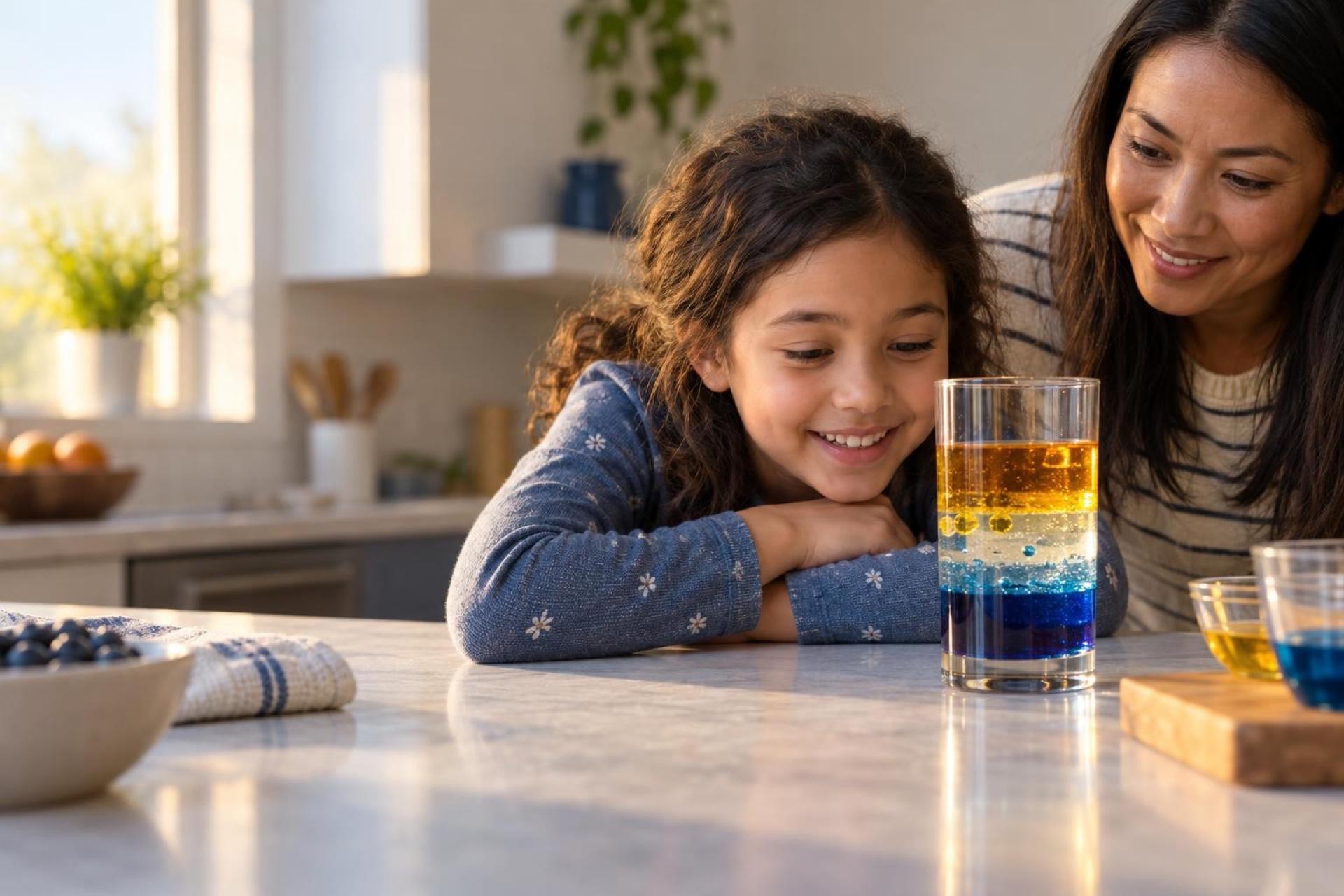
You need: a tall clear glass, honey or syrup, washing-up liquid, water with a drop of food colouring, and cooking oil.
- Pour in the honey first.
- Slowly add the washing-up liquid down the inside of the glass, then the coloured water, then the oil.
- Watch the liquids settle into layers.
What is going on: each liquid has a different density, which means a different amount of matter packed into the same space. The densest liquid sinks to the bottom and the least dense floats on top. Try dropping in a grape, a coin and a small piece of cork to see where each one stops.
 A live class on thisAP Physics 1 Practice and ReviewAges 13–17
Balloon rocket
You need: a long piece of string, a drinking straw, a balloon and tape.
- Thread the string through the straw and tie the string tightly between two chairs.
- Blow up the balloon and hold the neck closed.
- Tape the balloon to the straw, then let go.
What is going on: air rushes out of the balloon in one direction and pushes the balloon the other way. This is Newton's third law: every action has an equal and opposite reaction. It is the same idea that lifts a real rocket.
Change one thing: blow the balloon up more or less, or tilt the string uphill, and measure how far it travels.
Spinning eggs
You need: one raw egg and one hard-boiled egg that look the same.
- Spin each egg on its side on a smooth surface.
- Notice which spins fast and smoothly and which wobbles.
- Touch each spinning egg briefly to stop it, then let go at once.
What is going on: the boiled egg is solid, so it spins as one piece. Inside the raw egg the liquid lags behind the shell, so it wobbles. When you stop the raw egg and let go, the liquid inside is still moving and can start the egg turning again.
Wash hands after handling raw egg, and wipe the surface if one cracks.
The coin drop
You need: a glass, a playing card or piece of stiff card, and a coin.
- Put the card on top of the glass and the coin in the middle of the card.
- Flick the card sharply sideways with a finger.
What is going on: the card shoots away but the coin drops straight into the glass. Objects that are still tend to stay still unless a force moves them. This is called inertia. The flick moves the card too quickly for it to drag the coin along.
Keep a simple record
| Experiment | My prediction | What happened | Why I think so |
|---|---|---|---|
| Density tower | |||
| Balloon rocket | |||
| Spinning eggs | |||
| Coin drop |
If your child's explanation is not quite right, ask a question that tests it instead of correcting it. What would happen if we used a heavier coin? Then try it.
For more hands-on science, see our guides to safe chemistry experiments at home and building a simple circuit.
Frequently asked questions
What age are these experiments for?
They suit children from about 8 to 13. Younger children can join in with more adult help and simpler explanations.
Are they safe?
Yes, with normal kitchen care. Supervise younger children, keep liquids away from electronics and wash hands after the egg experiment.
My child asks why and I don't know the answer. What then?
Say so, and look it up together. Finding out is part of science, and it shows your child that adults keep learning too.
How can we take this further?
Turn one experiment into a fair test by changing a single thing and measuring the result. That is the basis of a science fair project.
Learn physics and chemistry with a teacher
Live classes turn experiments into real understanding, with a teacher to guide the questions.