By Amber Coleman ·
Safe Chemistry Experiments for Kids at Home
Simple safety rules for home chemistry: adult supervision, goggles, never mixing cleaners, plus five kitchen-safe experiments kids can try today.
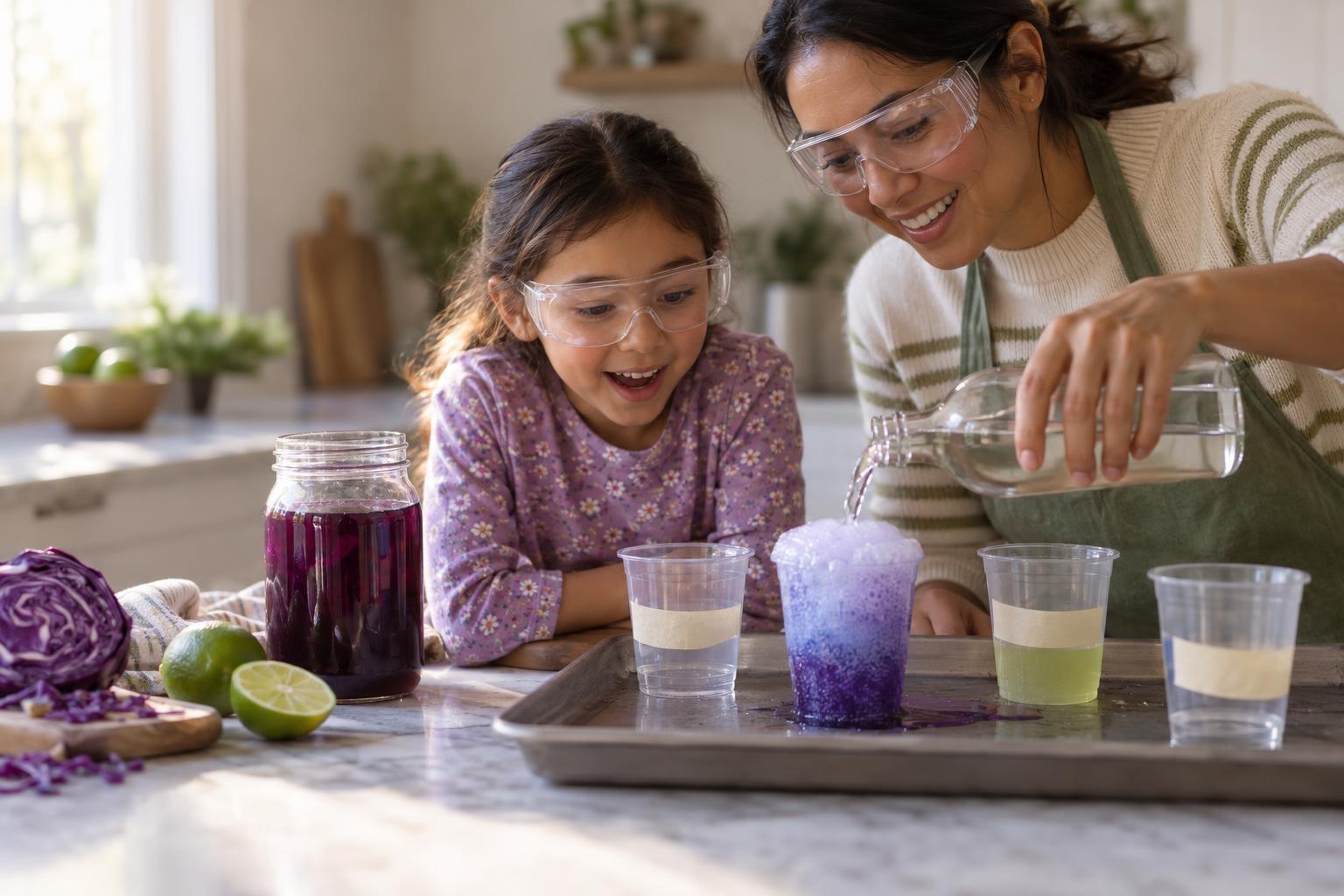
Home chemistry is safe when an adult supervises, everyone wears eye protection, and nobody ever mixes household cleaners. Stick to kitchen ingredients, follow the instructions as written, and clean up together. Below are the ground rules, a simple setup checklist, and five experiments that work well with kids.
An adult at the table, goggles on first, kitchen-safe ingredients only and no cleaning products anywhere near the experiment. Set up on a tray, label every cup, follow the steps exactly, then clean up and wash hands. Ask "why do you think that happened?" at the end to turn a fizz into real science.
The core safety rules
Go over these rules before every session, not just the first one. Kids remember rules better when they say them back to you.
- An adult is always present. Not in the next room, but at the table, watching.
- Goggles go on first. Safety glasses or splash goggles protect eyes from fizzing liquids and stray splashes. Regular glasses are not enough.
- Never mix cleaning products. Bleach mixed with ammonia or with acids like vinegar can release toxic gases. Keep cleaners out of the experiment area entirely.
- Use only kitchen-safe ingredients. Baking soda, vinegar, food coloring, salt, sugar, dish soap and red cabbage cover a huge range of experiments.
- No tasting, no sniffing up close. Even edible ingredients become "lab materials" once the experiment starts. Teach kids to waft a smell toward their nose with a hand instead.
- Follow the steps exactly. Doubling an amount or adding an extra ingredient can change what happens. Curiosity is great, but new ideas get checked with an adult first.
- Clean up and wash hands. Wipe surfaces, rinse containers and wash hands when you finish.
Set up a safe workspace
A good setup prevents most spills and mix-ups. It takes about five minutes.
- Work on a hard, easy-to-clean surface like a kitchen counter or a table covered with a plastic cloth.
- Put a baking tray or plastic bin under the experiment to catch overflow.
- Use clear plastic cups or old jars, and label each one with tape and a marker.
- Keep paper towels and a sink within easy reach.
- Tie back long hair and roll up loose sleeves.
- Keep younger siblings and pets out of the area.
- Open a window if you are working with vinegar or anything with a strong smell.
Five safe experiments to try
These use common kitchen items. Each one shows a real chemistry idea, so ask "why do you think that happened?" at the end.
1. Baking soda and vinegar fizz
Put a spoonful of baking soda in a cup on a tray. Add a few drops of food coloring, then pour in vinegar. The bubbles are carbon dioxide gas, made when an acid (vinegar) reacts with a base (baking soda).
2. Red cabbage color changer
An adult chops red cabbage and soaks it in hot water, then strains out the purple liquid. Kids pour small amounts into cups and add lemon juice, baking soda solution or plain water. The color shifts toward pink with acids and toward green or blue with bases.
3. Milk color swirl
Pour whole milk into a shallow dish and add drops of food coloring. Touch the surface with a cotton swab dipped in dish soap. The colors burst outward because soap breaks up the fat and changes the surface tension.
4. Dancing raisins
Drop a few raisins into a clear glass of plain sparkling water. Gas bubbles stick to the wrinkly raisins and lift them up, then pop at the top so the raisins sink again.
5. Growing salt or sugar crystals
An adult dissolves as much salt or sugar as possible in hot water. Once it cools, kids hang a string in the jar and check it each day. Crystals form as the water slowly evaporates.
What to watch for
Most kitchen experiments are low risk, but a few things deserve extra care.
- Heat: Any step with boiling water, the stove or the microwave is an adult job.
- Eyes: Vinegar and lemon juice sting. If something splashes into an eye, rinse it with clean water for several minutes and call your doctor if irritation continues.
- Online "challenge" experiments: Some viral videos use dry ice, strong acids, fire or cleaning products. Skip anything that is not clearly designed for kids.
- Swallowing: If a child swallows something that worries you, call Poison Help at 1-800-222-1222 in the US.
- Kits: Chemistry sets list a recommended age on the box. Follow it, and read the safety leaflet together first.
Make it real science
The safety habits above are also good lab habits. Encourage your child to keep a simple notebook for each experiment.
| Notebook section | What your child writes |
|---|---|
| Question | What am I trying to find out? |
| Prediction | What do I think will happen, and why? |
| Materials | Every ingredient and amount used |
| Observations | What I saw, heard or measured |
| Conclusion | Was my prediction right? What would I change? |
Changing just one thing at a time, such as the amount of vinegar, turns a fun fizz into a real experiment. A live class can take this further, with a teacher showing demonstrations and explaining the science behind them.
Frequently asked questions
What age can kids start doing chemistry experiments?
Preschoolers can enjoy simple color and fizz activities with an adult doing most of the pouring. School-age kids can follow written steps and record results. Always check the age label on any kit.
Do we really need goggles for kitchen experiments?
Yes. Fizzing reactions can splash, and vinegar or lemon juice in the eye is painful. Goggles also help kids treat the activity as real science.
Can we use the same cups and spoons for cooking afterward?
For pure kitchen ingredients, washing them well is usually fine. Many families keep a separate "lab" set of cups and spoons to avoid any confusion.
Which experiment is best to start with?
The baking soda and vinegar fizz is quick, uses two common ingredients and shows a clear reaction. Do it on a tray, with goggles on, and talk about the bubbles of carbon dioxide afterward.
Keep the experiments going with a live class
In a live chemistry and physics class, a teacher can demonstrate reactions and explain the science behind each one.