Science & natureAges 6–125 min read
By Amelia ·
Easy Weather Experiments for Kids
Make a rain gauge, a cloud in a jar and a wind vane with household items, and help your child keep a simple weather log.
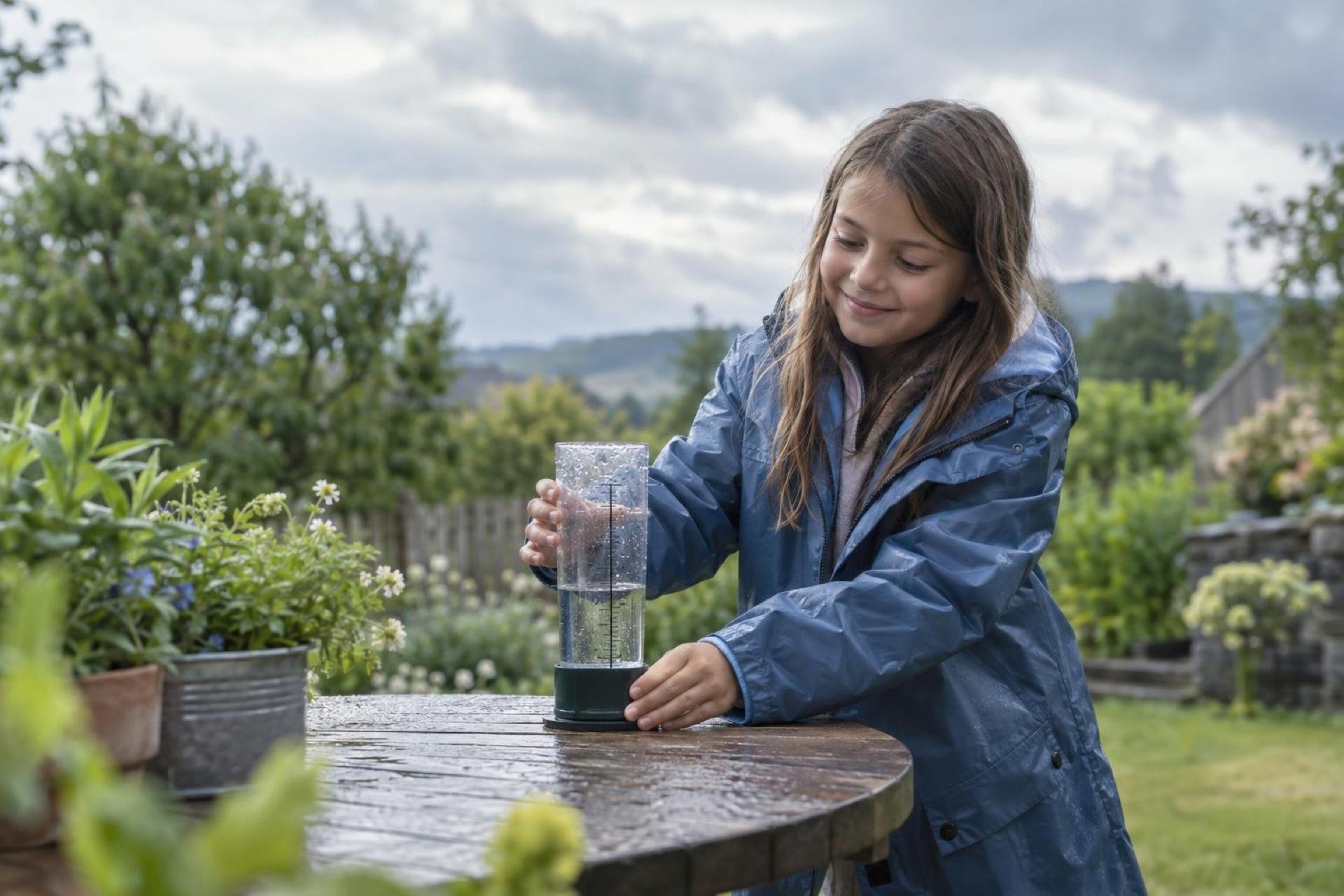
Weather is science your child can see from the window every day. With a jar, a ruler and a few things from the kitchen drawer, they can measure rain, make a cloud and find out which way the wind blows.
Start with one simple tool, such as a rain gauge, and record what it shows for a week or two. Measuring and writing down results is what turns a fun activity into real science.
Why weather is a good first science topic
Weather changes daily, costs nothing to watch and raises questions children already ask: where does rain come from, why is it windy, what are clouds made of? It also gives a natural reason to measure, record and compare, which are the habits science is built on.
Children aged 6 to 8 will enjoy building the tools and watching what happens. From about 9, they can keep a proper log, draw simple graphs and start making predictions.
Make a rain gauge
A rain gauge shows how much rain has fallen. You need a clear jar or bottle with straight sides, a ruler and tape.
- Tape the ruler to the outside of the jar with zero level with the inside bottom.
- Put the jar outside on a flat, open spot, away from trees and roof edges.
- Check it at the same time each day, write down the depth, then empty it.
After a week, ask your child which day was wettest and how much fell in total.
 A live class on this1st Grade Full Curriculum — Part 2Ages 5–7
Make a cloud in a jar
Clouds form when warm, damp air cools and the water vapour turns into tiny droplets around specks of dust. You can copy that in a jar.
- An adult pours a few centimetres of hot tap water into a large glass jar.
- An adult adds a quick spray of hairspray or aerosol into the jar.
- Put the lid on upside down straight away and place a few ice cubes on top.
- Watch a cloud form under the lid, then lift the lid and see it drift out.
The hot water and the spray are jobs for an adult. Hot tap water is enough; do not use boiling water in a glass jar.
The spray gives the water vapour something to cling to, just as dust does in the sky.
Make a wind vane
A wind vane shows where the wind is coming from. You need a straw, some card, a pin and a pencil with an eraser on top.
- Cut a small triangle and a larger rectangle from card. Slot the triangle into one end of the straw and the rectangle into the other.
- An adult pushes the pin through the middle of the straw and into the pencil eraser, loosely enough for the straw to spin.
- Stand the pencil in a pot of soil or modelling clay outside.
The pointed end swings to face the wind. Use a compass or a phone compass to mark north, then record the wind direction each day.
Keep a weather log
A simple table is enough. Fill it in at the same time each day for two weeks.
| What to record | How |
|---|---|
| Rain | Depth in the rain gauge |
| Wind | Direction from the wind vane; calm, breezy or strong |
| Sky | Clear, some cloud or overcast, with a quick sketch |
| Temperature | An outdoor thermometer in the shade, if you have one |
| Prediction | What your child thinks tomorrow will bring |
Each evening, compare your child's prediction with what happened and with the official forecast. Being wrong is part of the fun, and it shows why forecasters need so much data.
If your child enjoys recording what they see outdoors, our guide on starting a nature journal is a good next step.
What parents can do next
- Build the rain gauge this weekend and choose a spot for it.
- Pick a daily time to check it, such as after school.
- Add the wind vane or the cloud in a jar the following week.
- After two weeks, look back at the log together and ask what patterns your child can see.
Frequently asked questions
What age are these experiments for?
Children from about 6 can help build and observe with an adult. From about 9, most can run the weather log on their own.
What if it doesn't rain?
A dry week is still a result. Record zero, keep tracking wind and sky, and compare with a wetter week later.
Do we need a thermometer?
No. It is a useful extra, but rain, wind and sky give plenty to record.
Can we do this in a flat with no garden?
Yes. A balcony or an outside window ledge works for a rain gauge if it is open to the sky, and the cloud in a jar is an indoor activity.
Take the curiosity further
Live science classes let children run experiments with a teacher and ask all the questions they have.