Compare programs & platformsAges 5–174 min read
By Amelia ·
Live Online Classes vs Self-Paced Apps: What Works for Kids?
Live classes with a teacher or a self-paced app? How the two compare for kids on motivation, feedback, cost and flexibility, and how to combine them.
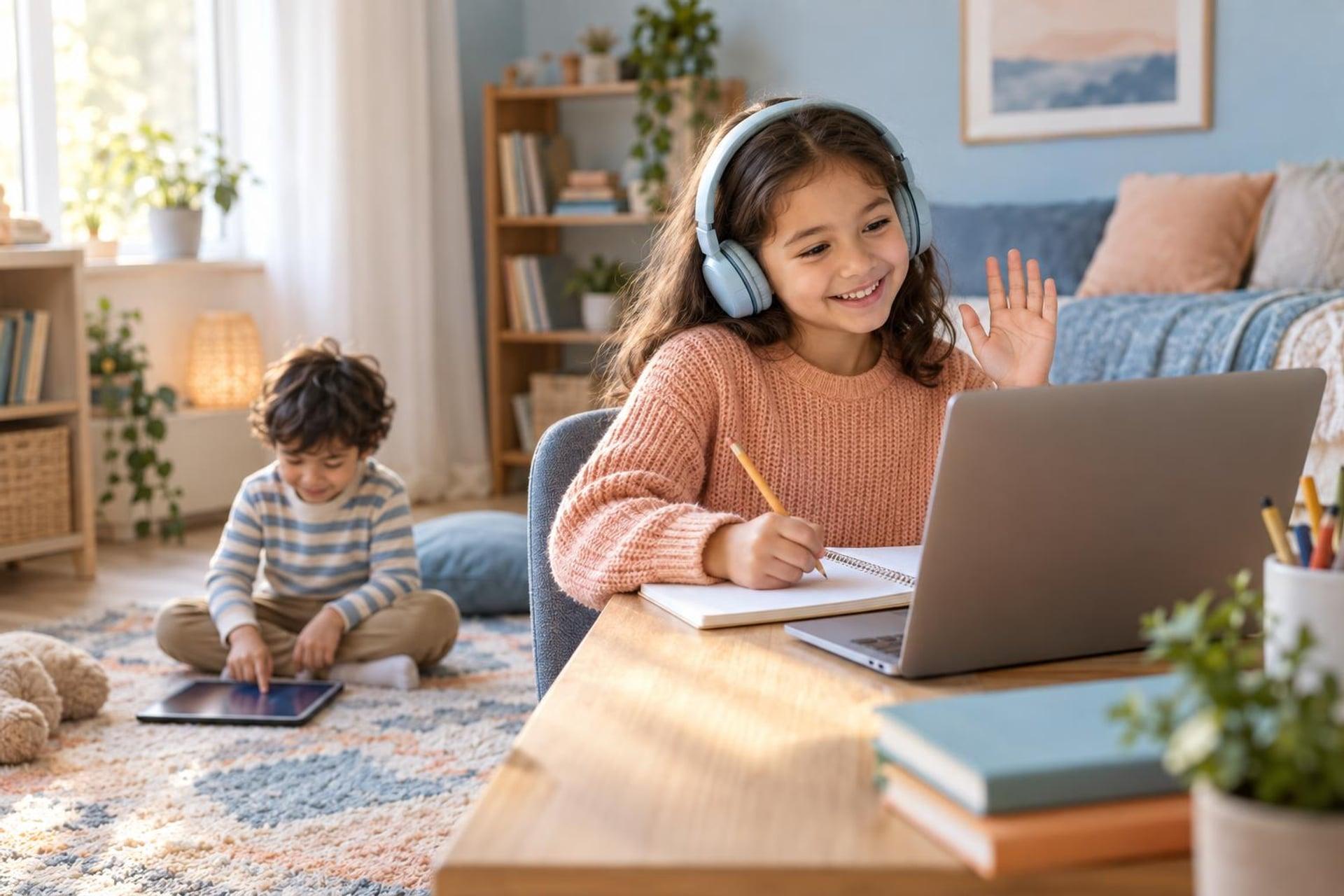
Your child has a learning app on the tablet that has not been opened in three weeks, and you are wondering whether a live class would be any different. The two work in different ways, and they are good at different things.
Self-paced apps are good for practice and flexible timing. Live classes are better for feedback, motivation and anything that involves discussion or making. Many children do best with a live class for learning and an app for practice.
How they differ
| Self-paced app or video course | Live online class | |
|---|---|---|
| When | Any time | A set time each week |
| Feedback | Automatic: right or wrong | A teacher responds to your child's own work |
| Motivation | Points, streaks and badges | A teacher and classmates who expect you |
| Pace | Your child's own | The group's, adjusted by the teacher |
| Cost | Usually lower | Usually higher per hour |
| Best at | Drills and repetition | Explaining, discussing, creating |
Where self-paced apps work well
Apps are strong for skills that improve through repetition, such as times tables, spelling, typing and vocabulary. They fit into spare minutes and let a child repeat something without embarrassment.
- Your child is self-motivated and likes working alone.
- The skill has clear right and wrong answers.
- Your schedule changes from week to week.
- You want low-cost practice between lessons.
Streaks without learning. A child can keep a streak alive by tapping through easy levels. Look now and then at what they can do without the app.
 A live class on this3-Ingredient Peanut Butter Cookies — Step-by-StepAges 3–8
Where live classes work well
A teacher can see how a child reached a wrong answer and respond to that. For writing, art, coding projects, speaking and anything open-ended, that feedback is the point. A fixed time and familiar faces also solve the commonest problem with apps, which is that nobody notices if you stop.
- Your child gives up when stuck and needs someone to ask.
- The subject is creative or involves discussion.
- They are motivated by other children.
- They need structure to keep going.
Try one live class before committing. Watching your child for a single session tells you more than any description.
Five questions to help you decide
- Does my child finish things without reminders?
- Is there a right answer, or does the work need a human response?
- Do they light up around other children, or prefer to work alone?
- What happened with the last app or video course we tried?
- What can we afford every month without stress?
Mostly 'alone, right answers, finishes things' points to an app. Mostly 'needs people, open-ended, loses steam' points to a live class.
Using both together
New ideas, feedback and questions.
Short daily practice of the same skill.
A weekly glance at what was actually learned.
Every couple of months, keep what works.
For help choosing between live formats, see online clubs, classes or 1-on-1 tutoring. If you are comparing platforms, we also cover Outschool alternatives.
What parents can do next
- Answer the five questions honestly for your child.
- If apps have stalled before, book one live class as a test.
- Keep an app for ten minutes of practice a day if it helps.
- Review in two months and drop whatever is not being used.
Frequently asked questions
Are live online classes worth the extra cost?
They are when your child needs feedback, structure or other children to stay engaged. For pure drill, an app may be enough.
Is screen time different in a live class?
Yes. A live class is interactive: children speak, make things and respond to a teacher, which is different from passive watching.
What age suits live online classes?
Many children manage short live classes from about 5, with a parent nearby. Attention spans and class lengths grow with age.
My child is shy on camera. Will a live class work?
Small groups and patient teachers help. Many children start by listening and join in after a few sessions.
Try a one-time class
A single live class is a low-commitment way to see how your child responds to a teacher and a small group.