By Morgan Lee ·
Is My Child Overscheduled?
Signs a child is overscheduled—and how parents can add space without dropping everything that matters.
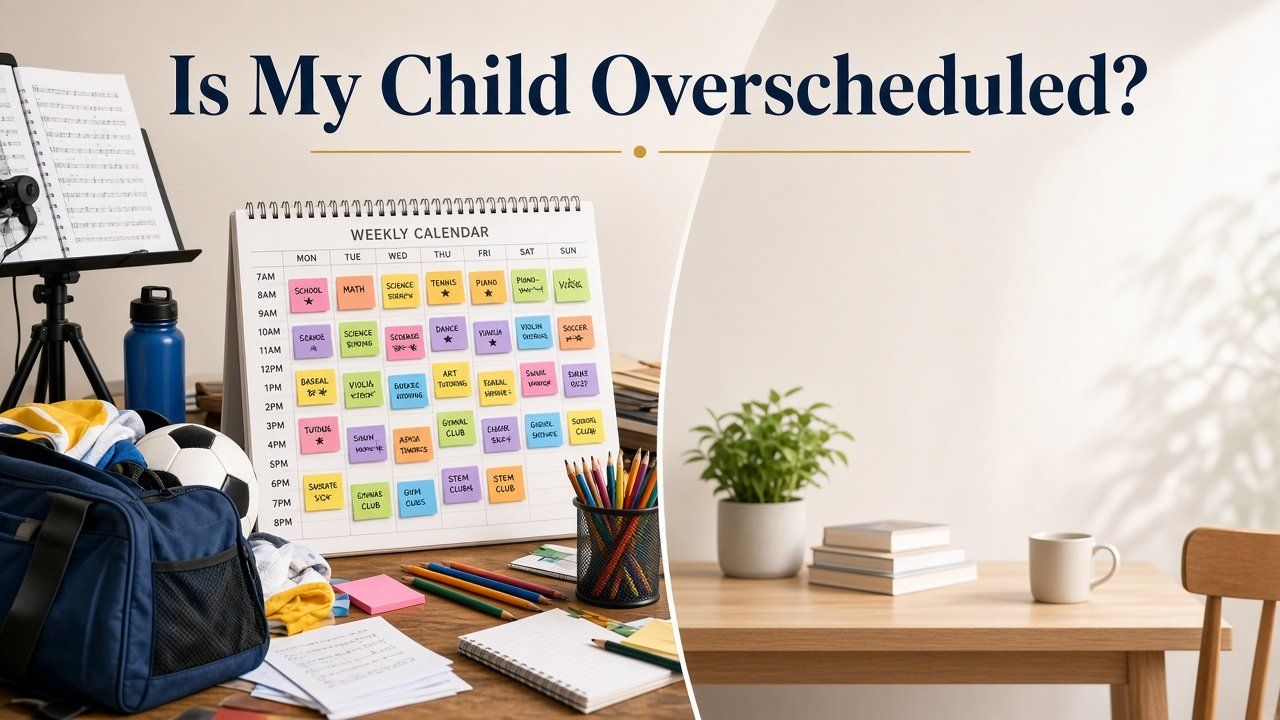
Is My Child Overscheduled?
A full calendar can contain wonderful activities and still be too full. The test is whether the child and family can recover, practice and participate without living in constant transition.
Extracurriculars can build skill, friendship and identity. They can also stack until weekdays become a relay of car lines, hurried dinners and homework at nine p.m. Children who chose every activity may still be overscheduled. The question is not whether the calendar looks impressive; it is whether the baseline week leaves sleep, school, relationships and unscheduled mind-wandering intact.
Count the hidden hours
List every commitment on a typical week—not the exceptional recital week. For each, add travel, gear changes, warm-up, waiting for siblings, makeup work missed at school and parental coordination time. A sixty-minute lesson often consumes two hours of evening; a weekend tournament can erase half a Saturday of recovery.
Include homework and sleep as immovable blocks before judging “free” space. What remains after foundations is the real budget for activities. Spreadsheets feel tedious; they prevent the common error of counting only scheduled start times on a portal.
Hidden hours also include mental load: remembering forms, costumes, snacks and coach emails. Children absorb that stress even when they are not driving.
Watch recovery and mood
Signals of overload include persistent fatigue, irritability after school, dread on activity days, rushed or skipped meals, difficulty falling asleep despite exhaustion and weekend collapse—not gentle rest, but crashing. Some children become hyper-compliant and anxious rather than oppositional; quiet burnout counts.
Compare mood on open afternoons versus packed ones. Temporary grumpiness before a big game differs from a month of low-grade misery. Ask teachers whether focus or homework quality shifted since the schedule filled.
Recovery metrics matter for the whole family. If parents live in permanent logistics mode, the child learns that busyness is normal—and may inherit your pace without your coping skills.
Protect free play and friendship
Unstructured time is not a hole to fill with enrichment. Children need room to initiate games, talk without agenda, read horizontally and bore themselves into creativity. Friendship maintenance requires overlap—not only structured playdates booked three weeks out.
When every block is adult-led, children lose practice negotiating rules, repairing conflict and choosing activities. Those skills show up in classroom collaboration and adolescent social life later.
Protect at least one recurring open block per week at the family level, even if it means disappointing a coach or tutor. Treat it as seriously as a lesson fee you already paid.
Distinguish temporary intensity
Performance weeks, playoffs and exam seasons legitimately tighten the calendar. Evaluate the baseline month, not the peak. If intensity never returns to breathable, the schedule—not the child—needs adjustment.
Plan downshifts after peaks: fewer optional rehearsals, protected sleep, no new enrollments until recovery. Schools and studios sometimes offer lighter terms; ask before assuming the next session must be identical.
Rank commitments
For each activity, ask what it provides: joy, mastery, belonging, physical health, required team role or mainly fear of falling behind peers. Identify the commitment kept from guilt, sunk cost or parental identity (“we are a hockey family”).
Invite the child’s view without surrendering judgment. They may want to quit the activity that builds social skills while clinging to one that drains them because friends are there. Use rankings to start conversation, not to dictate from a spreadsheet.
Make a minimum viable week
Define non-negotiables first: adequate sleep for age, school attendance and homework realism, family meals or connection points, movement and at least one unscheduled block. Fit activities around those foundations rather than hoping foundations survive a packed grid.
Minimum viable does not mean joyless. It may mean one deep commitment plus one lighter social activity instead of four parallel tracks. Depth often beats breadth for skill and sanity.
Review each term
Do not auto-renew registrations. At term end, ask what the child learned, whether they want deeper involvement and what the family must trade to continue—money, sibling time, dinners, your bandwidth. Write the decision so spring does not repeat fall by inertia.
Include the child in renewal talks at an age-appropriate level. Even partial voice reduces resentment and teaches planning.
How this changes from ages 8 to 14
Younger elementary children rely on adults to guard whitespace; they cannot opt out of drives you schedule. Cap activities explicitly and watch for meltdowns that signal too many transitions.
Middle grades often want social belonging through teams and clubs. Peer pull intensifies; your ranking conversation should name social needs honestly. Help them choose where friends actually are versus where they wish they were.
Early teens may take on leadership roles with real obligation to groups. Honor those commitments while still protecting sleep. Co-design calendar edits rather than imposing cuts during an argument.
Common parent traps
- Treating a busy calendar as proof of good parenting
- Adding tutoring without removing another demand
- Assuming resistance means laziness rather than overload
- Matching sibling schedules for fairness instead of individual need
- Continuing expensive programs because of sunk cost
A four-week review
After one schedule change—dropping, shortening or shifting an activity—track sleep, mood at homework time and one school indicator. Review weekly with your child. At four weeks, decide continue, adjust again or restore something you cut. Document the reason to avoid yo-yo enrollments driven by guilt.
Frequently asked questions
There is no universal number. Total time, intensity, travel, school load and the child’s functioning matter more than counting badges on a profile.
No. Unstructured time supports recovery, independent play, friendships and self-directed interests that structured programs rarely replicate.
Fairness does not require identical counts or costs. Explain family constraints transparently and match opportunities to each child’s needs and capacity.
Review note
Programs, seasons and family circumstances change. This guide is educational, not clinical advice. Concerns about anxiety, depression or school refusal deserve qualified support beyond calendar edits alone.