Math, logic & chessAges 3–55 min read
By Olivia ·
Preschool Math Games You Can Play at Home
Simple counting, sorting and shape games for ages 3–5 using things you already have, plus signs your preschooler is ready for more.
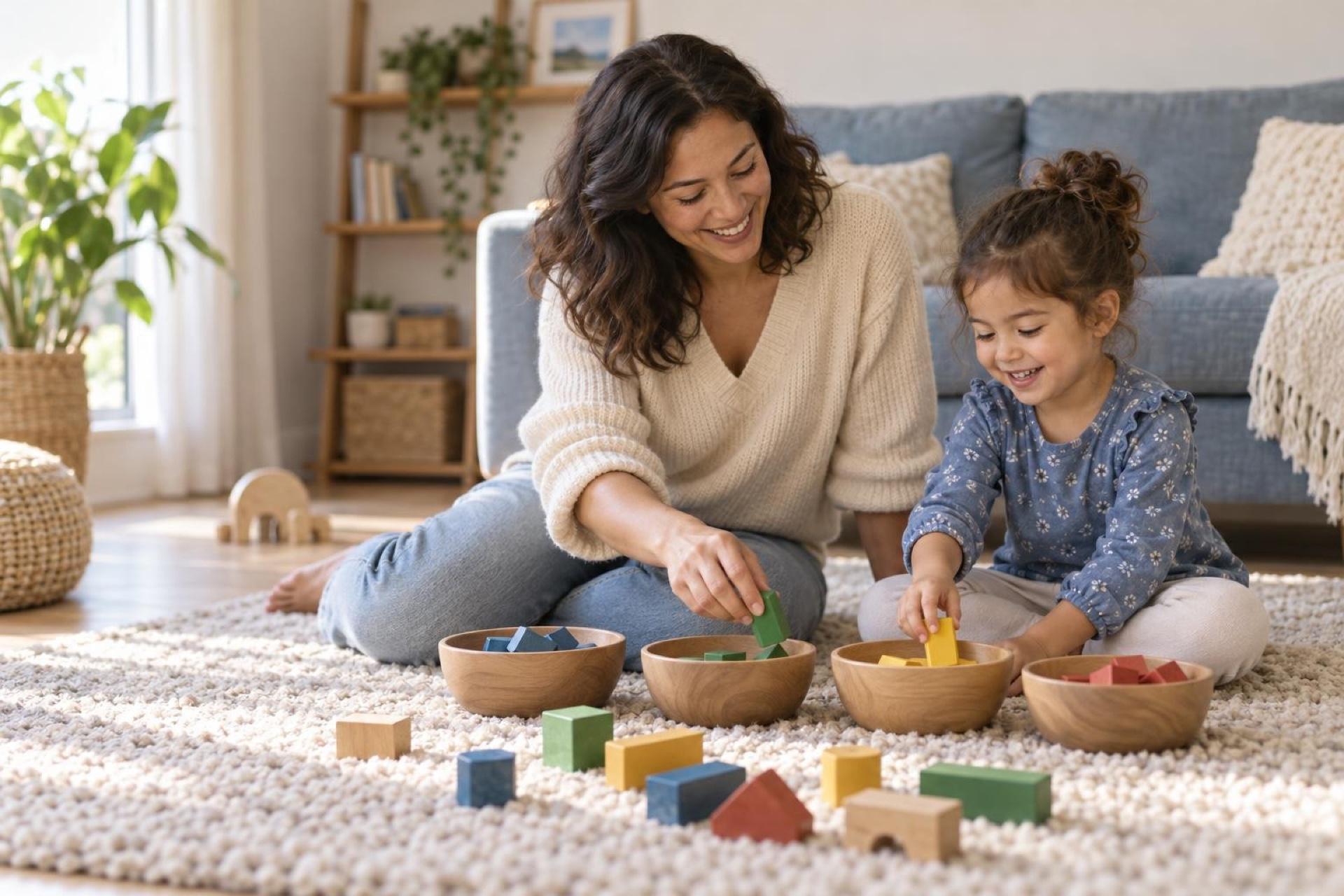
Your preschooler does not need worksheets to get good at math. Counting stairs, sharing out snacks and sorting socks all build the same early skills, and they take less time than finding a pencil.
For ages 3 to 5, math grows through short, playful moments with real objects. Aim for a few minutes of counting, sorting, comparing and shape-spotting each day, and stop while your child is still enjoying it.
What early math looks like at ages 3 to 5
Before children work with written numbers, they need to understand what numbers mean. That starts with touching one object for each number word, noticing which pile has more, spotting patterns and naming shapes.
Children pick these ideas up at different speeds. A three-year-old may count to ten out loud but lose track when counting actual blocks. That is normal. Saying the words and counting real things are two separate skills, and the second one takes practice.
Touching or moving one object for each number word.
More, fewer, bigger, smaller, longer, shorter.
Grouping by colour, size or shape, and noticing what comes next.
Naming shapes and using words like under, next to and behind.
Counting games for everyday moments
Count the stairs
Count each step out loud as you climb. On the way down, try counting backwards from the top number. Once that is easy, count only every second step together.
Snack share
Put a small pile of crackers or grapes on the table and ask your child to give each person the same amount. Sharing one at a time is an early version of division, and it shows your child that fair means equal.
How many in the bag?
Drop a few toys into a bag, counting as you go. Take one out and ask how many are left. Let your child tip them out and check. Keep the numbers small, up to five at first.
When your child miscounts, count again together and move each object as you say the number. Showing works better than correcting.
 A live class on this1st Grade Full Curriculum — Part 2Ages 5–7
Sorting and pattern games
Laundry sort
Ask your child to match the socks or to put all the small clothes in one pile and the big ones in another. Then ask which pile has more.
Bead or block patterns
Lay out red, blue, red, blue and ask what comes next. When that is easy, try a pattern with three parts. Let your child make a pattern for you to finish too.
Tidy-up sort
At clean-up time, sort toys by type: cars here, animals there. Sorting is one of the earliest forms of data handling, and it gets the floor cleared.
Shape and size games
Go on a shape hunt around the house. Plates are circles, doors are rectangles, and a slice of toast cut corner to corner makes two triangles. Ask your child how they know: how many sides, how many corners.
For size, line up three shoes from shortest to longest, or fill two different cups with water and guess which holds more before pouring one into the other.
| Skill | Game | Words to use |
|---|---|---|
| Counting | Count the stairs | One more, one fewer, how many |
| Sharing | Snack share | Same, equal, left over |
| Sorting | Laundry sort | Match, group, more, fewer |
| Patterns | Block patterns | Next, repeat, again |
| Shapes | Shape hunt | Side, corner, round, straight |
Keep it short and fun
Five minutes is plenty. Preschoolers learn in short bursts, and several small moments across the day do more than one long session at the table.
Follow your child's lead. If they want to count dinosaurs instead of blocks, count dinosaurs. If they lose interest, stop and come back to it tomorrow.
If your child gets upset or starts guessing wildly, the numbers are probably too big. Go back to amounts up to three or five and build up slowly.
Signs your child is ready for more
- They count ten objects accurately, touching each one once.
- They can tell you which of two small groups has more without counting.
- They start asking number questions of their own, such as how many days until a birthday.
- They recognise some written numerals on doors, clocks or books.
At that point you can add simple board games with a dice, number books and, if your child enjoys a group, a short live class. Our guide on whether online classes work for children under 6 explains what to look for.
What parents can do next
- Pick one counting game and one sorting game to try this week.
- Use math words in everyday talk: more, fewer, same, next.
- Keep each game under ten minutes and end on a win.
- Notice which games your child asks for again, and repeat those.
Frequently asked questions
Should my preschooler use math worksheets?
They are not needed at this age. Real objects teach the same ideas more clearly, and most young children enjoy them more.
My child skips numbers when counting. Is that a problem?
No. Skipping or repeating numbers is very common at three and four. Keep counting together with real objects and it usually settles with practice.
How high should a preschooler be able to count?
It varies a lot. Counting a small group of objects accurately matters more than reciting a long string of numbers.
Are math apps good for preschoolers?
A well-made app can be a small extra, but hands-on play with you does more at this age. If you use one, sit together and talk about what is on the screen.
Find a playful early learning class
If your child lights up when counting and sorting, a short live class with a small group can add songs, stories and new games.