By Rowan Ellis ·
Executive Function Skills for ADHD
What executive function skills parents can teach kids with ADHD—planning, starting, organizing and recovering without constant conflict.
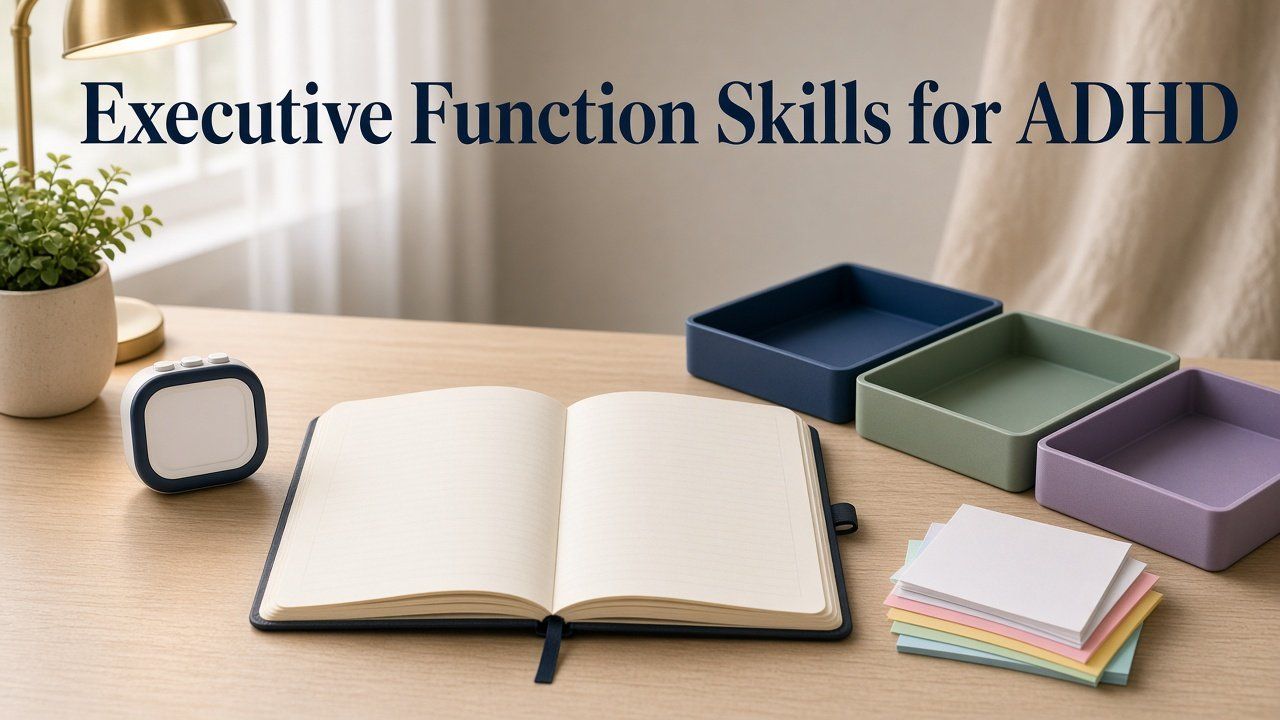
Executive Function Skills for Kids With ADHD: What Parents Can Teach
Executive skills do not reliably improve through repeated reminders. Children need tools, modeling, guided practice and a gradual handover of responsibility.
What executive function looks like in daily life
Executive function helps a child remember instructions, start work, shift between tasks, estimate time, organize materials and check results. When these skills are hard, the same child who cares about school can still look careless from the outside. Forgotten folders, stalled homework and last-minute rushes often reflect planning and initiation gaps—not a lack of effort or character.
Parents often respond with more reminders because reminders feel like the obvious fix. Reminding can get one evening done; it rarely teaches the child how to run the next evening without the same adult voice. The more useful question is which hidden step is missing: knowing the goal, gathering materials, choosing the first action, judging time or noticing when the work is finished. Naming that step turns vague frustration into a skill you can practice.
Difficulty can look like carelessness even when the child is trying. Separating “trying” from “managing the sequence” protects the relationship and points you toward tools instead of lectures. Executive skills grow through explicit instruction and guided practice, not through hoping the child will suddenly become organized after enough warnings.
Teach the hidden questions
Model aloud the questions strong planners ask quietly: What is the goal? What do I need? What comes first? How long might it take? How will I know I am done? Say them while packing a backpack, starting homework or preparing for the morning. Repetition turns an invisible process into a usable routine the child can eventually ask themselves.
At first the adult supplies most of the questions. Then the child answers one or two. Later the child leads the checklist while the adult only prompts if something is skipped. That gradual handover is the teaching method. Without it, the child may complete tasks with heavy support and still not own the planning language that makes independence possible.
Keep the questions short and the same each time. Consistency matters more than clever new scripts. A sticky note with five lines on the desk can replace a parent’s repeated verbal coaching once the child knows what the lines mean.
Use external supports without shame
Checklists, calendars, alarms, labeled folders and visual schedules are tools, not cheating. Adults use systems too—shared calendars, phone reminders, labeled drawers. Framing supports as something only “kids who struggle” need creates shame and makes the child hide the tools they still require. The goal is for the child to operate the support increasingly independently, not to prove they can manage without any system.
Choose supports that are visible and simple enough to maintain. A beautiful complex planner that depends on perfect daily upkeep is unlikely to last. One checklist for backpacks, one place for unfinished work and one alarm for transitions often beat an elaborate color-coded system nobody updates. When a tool fails, adjust the tool—do not treat the failure as proof the child “just doesn’t care.”
Practice time estimation
Before a task, ask the child to predict how long it will take; afterward, compare the prediction with reality. Keep the comparison neutral. Building an internal sense of time requires repeated feedback without criticism. If every miss becomes a lecture, the child stops guessing honestly and starts defending.
Start with short, concrete tasks: brushing teeth, packing for soccer, finishing five math problems. Over time, predictions can grow to larger homework blocks. Timers help make time visible, but the skill is the prediction-and-review loop, not the device alone. Avoid using the difference between guess and actual time as evidence of laziness; use it as data for the next plan.
Make organization concrete
Give every important item a visible home and reduce the number of steps needed to put it away. A hook by the door beats a closed closet that requires opening, hanging and remembering. A tray for homework materials beats a backpack that swallows papers. Organization fails most often when the “put away” path is long, abstract or easy to skip when the child is tired.
Reduce clutter before adding labels. Fewer categories are easier to maintain. If the child cannot see the home for an item, the system exists only in an adult’s mind. Walk the system together until the child can place items without being told where they go—then fade the prompts while keeping the homes.
Review, do not rescue
Use a short daily or weekly check: what worked, what was forgotten and which tool needs adjustment? Rescue skips learning; review keeps support while still teaching. Natural consequences can teach—missing a nonessential item once may matter—but avoid withholding essential support merely to prove a point. The child still needs a working system for school materials, sleep and safety.
A review meeting should stay brief and specific. Celebrate one improvement, name one stuck point and change one support. Overhauling everything after a hard week recreates the same overwhelm the child already feels. Steady, small adjustments teach that systems can be revised without shame.
Measure independence
Track whether the child starts with fewer prompts, returns after breaks, finds materials and notices errors. Perfect neatness is not the objective. Independence looks like initiating the checklist, adjusting when something is missing and asking for help after trying a step—not like a spotless desk that an adult still manages behind the scenes.
Write down a baseline for one routine: how many prompts to start homework, how often materials are found without searching the house, whether the child catches a missed step. Revisit the same markers after a few weeks. Progress in executive skills is often quiet. Measuring independence keeps parents from mistaking temporary adult scaffolding for permanent dependence—or from removing supports before the child can run them alone.
Frequently asked questions
Yes, children can learn strategies and tool use through explicit instruction and guided practice.
They are an external support. The aim is independent use, not removal before the child is ready.
No. Profiles differ, so supports should be individualized with appropriate professional input.
Review note
Programs, prices and policies can change. Review current provider information. Educational, developmental and health concerns should be discussed with qualified professionals familiar with your child.