By Olivia ·
Is Chess Good for Kids? Benefits and Realistic Expectations
Chess can help children practice planning, patience, and problem-solving. Learn what benefits are realistic—and how to find a good fit.
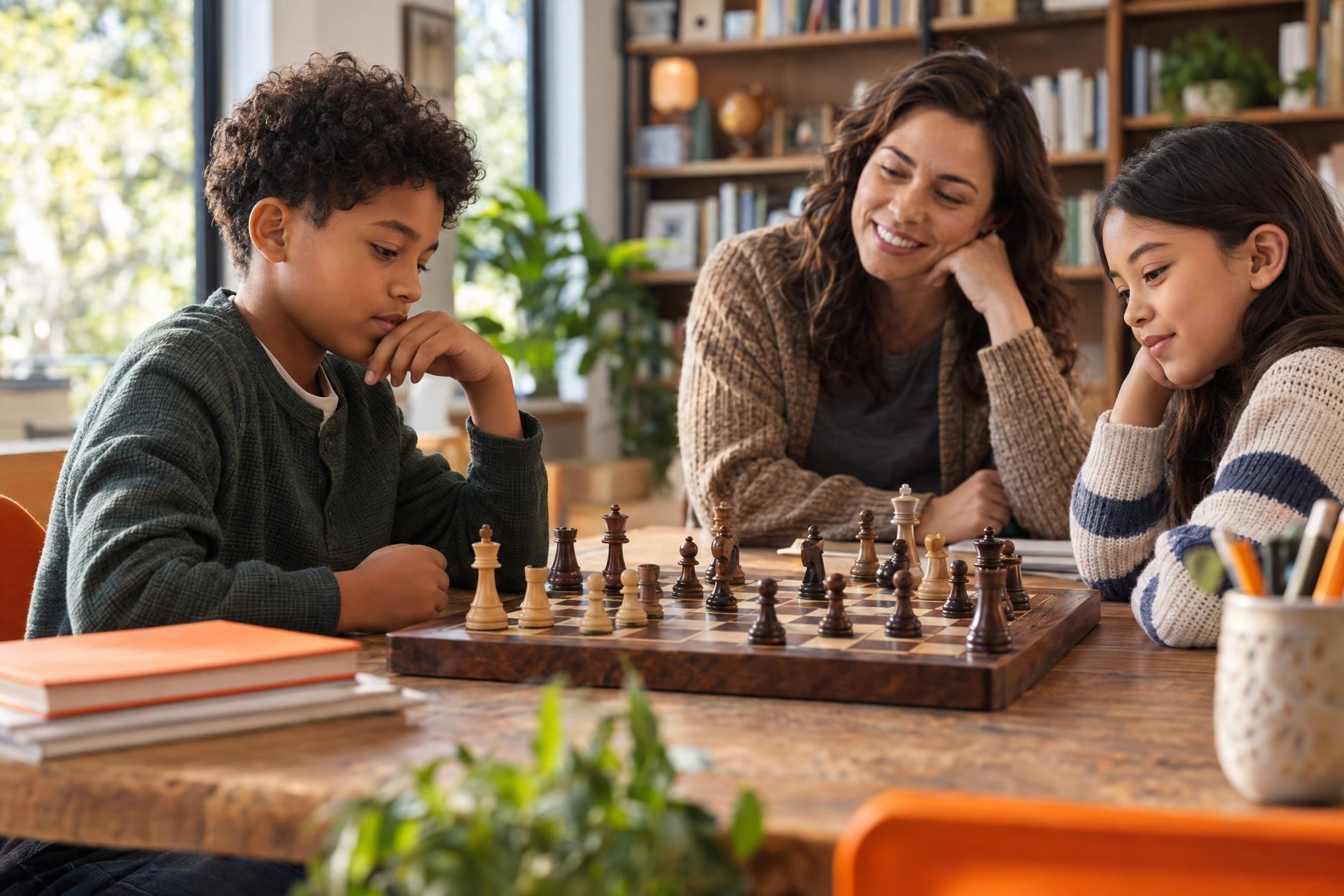
Chess may be good for kids—but not for the reason the internet often claims.
You may have heard that chess makes children smarter, improves math scores, or gives them a major academic advantage. Those are appealing promises, especially when you are choosing among many after-school activities. But they set the bar in the wrong place.
The strongest case for chess is simpler and more practical: it gives children repeated chances to pause, look closely, make a choice, imagine what might happen next, and adjust when a plan does not work. In a supportive setting, it can also make mistakes feel manageable. That is valuable practice, whether or not it leads to a measurable change in grades.
Chess can be a worthwhile hobby for children who enjoy games, puzzles, and figuring out how things work. Its clearest benefits happen within the game: children practice pausing before a move, considering options, recognizing patterns, and responding to mistakes. It is not a shortcut to higher grades, stronger math scores, or a general boost in intelligence. The best test is practical: does your child enjoy the challenge, feel safe making mistakes, and gradually become more thoughtful about their choices?
Chess is not the right hobby for every child, and it is not a shortcut to academic success. Still, for a child who enjoys games, puzzles, stories, or figuring out how things work, it can be a rich and enjoyable way to practice strategic thinking.
What children are really practicing when they play chess
A chessboard creates a clear, contained problem: What should I do now? There are rules, choices, consequences, and another person whose next move matters. Children do not need to master all of that at once. Over time, though, a good chess experience invites several useful habits of mind.
Planning ahead—one move at a time
Young beginners often want to move the first piece they notice. That is a perfectly normal starting point. Chess gives them a reason to slow down and try a simple routine:
- What is my opponent threatening?
- What choices do I have?
- What might happen after my move?
At first, “thinking ahead” may mean noticing that a knight could be captured. Later, it may mean setting up a two-move plan or deciding which trade is worthwhile. The point is not that a child always chooses the best move. It is that they get practice making a decision for a reason, rather than acting purely on impulse.
Seeing another person’s options
Chess also asks a child to consider the board from the other player’s side: “If I move here, what can they do?” That is perspective-taking within a game. It is not the same as a broad social-emotional skill, but it is a concrete and accessible exercise in recognizing that another person has goals, choices, and possible responses.
Recognizing patterns
As children play, they begin to recognize familiar situations: an unprotected piece, a line that opens toward the king, a useful way to develop pieces, or a basic checkmate pattern. Pattern recognition is part of becoming more comfortable with any complex activity, from reading music to playing a sport. Chess gives children lots of small, visible opportunities to notice, remember, and test patterns.
Learning from a specific mistake
A lost queen can feel enormous to a child. A thoughtful coach or parent can make the moment less personal and more useful: “Let’s go back one move. What did you notice then? What else could you have tried?”
That conversation does not erase disappointment. It does, however, turn a vague feeling of “I’m bad at this” into a concrete next step. A child might learn to check whether a piece is defended before moving it, or to look for checks and captures before making a casual move.
Does chess make kids smarter or better at math?
The honest answer is: we should be careful with that claim.
Research on chess instruction has reported promising effects on some cognitive and academic measures. But the research is mixed, and study design matters a great deal. Children who take chess may also be receiving extra adult attention, enjoying a novel activity, or participating in a program that differs from what the comparison group receives. Those factors can affect results.
Reviews of the evidence have raised an important concern: when studies use stronger designs—especially when chess is compared with another engaging activity rather than with no additional activity—the apparent broad benefits often become smaller or uncertain. A meta-analytic review of chess, music, and working-memory training found little support for broad “far transfer,” meaning reliable gains in unrelated abilities simply from training one activity. A review of chess-instruction research similarly notes promising findings alongside major methodological limitations.
Chess should not be sold as a way to raise IQ, guarantee stronger math performance, or replace direct instruction and support in subjects where a child needs help.
A more realistic expectation is this: chess helps children practice chess-related thinking—planning, evaluating options, noticing patterns, and recovering from mistakes. Some children may carry parts of those habits into schoolwork or everyday decisions, especially when adults help them reflect on the connection. But that transfer varies from child to child and should not be assumed.
| A realistic reason to choose chess | A promise to be skeptical of |
|---|---|
| It gives my child an enjoyable way to practice pausing and planning. | It will make my child generally smarter. |
| It can offer manageable challenges and feedback after each move. | It will reliably raise grades or math scores. |
| It can create low-stakes opportunities to respond to mistakes. | It will fix attention, behavior, or learning difficulties. |
| It may be a great fit for a child who likes puzzles or strategy games. | Every child needs chess to succeed. |
Can chess help a child practice patience?
It can provide opportunities to practice patience, but it does not automatically create it.
Chess asks players to wait, look again, and tolerate uncertainty. A child may want to attack immediately, only to realize that their opponent has an easy response. With time and supportive instruction, they can learn that taking a brief pause often helps.
That practice works best when the game fits the child’s developmental stage. Asking a brand-new seven-year-old to sit through a long, silent game is more likely to create frustration than thoughtful patience. Short formats, mini-games, puzzles, and frequent breaks can make the same skills approachable.
Patience is not sitting still for the longest time. In chess, it can be as small as taking ten seconds to notice one more option before moving.
It is also important not to treat chess as treatment for attention difficulties, anxiety, learning differences, or behavioral challenges. Families who have concerns in those areas should seek appropriate support. Chess can be an enjoyable hobby alongside that support, but it is not a substitute for it.
What about children who hate competition?
A child does not need to be intensely competitive—or especially “academic”—to enjoy chess. The first experience matters more than a child’s label.
Some children love the head-to-head challenge of a match. Others would rather solve a puzzle with a partner, learn how each piece moves, or play a short game with a friendly time limit. All can be legitimate ways into chess.
Focus on one skill, such as capturing safely or protecting pieces.
Try simple checkmate puzzles before a full game.
Let two children talk through possible moves together.
Use shorter rounds rather than lengthy tournament-style games.
Look for beginner instruction that celebrates a thoughtful idea, not only a win, and offers clear, kind feedback after a game.
A short sibling game and review
Two siblings might play a 10-minute game and then each name one move they felt proud of and one move they would reconsider. This keeps the focus on noticing and learning rather than on who was “better.”
How to tell whether chess is a good fit for your child
You do not need to predict whether your child will become a strong player. Start with a low-pressure introduction and watch what happens.
Chess may be a good fit if your child:
- enjoys puzzles, board games, strategy games, or figuring out rules;
- likes asking “what if?” questions;
- is curious about how the pieces move, even before wanting to play a full game;
- can handle short challenges with support; or
- takes satisfaction in improving a small skill over time.
It may not be the right activity right now if every game ends in distress, the instruction moves too quickly, or the child feels pressured to compete. That is not a failure. It may mean they need a gentler format, a break, or a different hobby that better matches their current interests.
A useful family test: Does my child enjoy the challenge, feel safe making mistakes, and gradually become more thoughtful about their choices? If the answer is mostly yes, chess is doing something worthwhile.
What parents can do next
Parents do not need to know chess well to support a child’s experience. A few small choices can keep the game from becoming a test of ability.
- Start small. Learn the pieces in stages, try a puzzle, or play a short mini-game before expecting full matches.
- Praise the process you can see. Try “You stopped and checked that square” rather than “You’re so smart at chess.”
- Keep post-game review brief. One useful moment is enough. Reviewing every error can feel overwhelming.
- Model calm after a loss. You might say, “That move surprised me. Next time I’ll look for that sooner.”
- Let interest lead. A child who wants to play once a week is not less successful than one who wants tournaments. There is room for both.
Chess is one valuable option among many. It should complement physical activity, creative play, friendships, direct academic help when needed, and the other interests that make up a full childhood.
The bottom line
Chess is good for many kids because it is a structured, engaging game where choices matter. It can give children repeated practice with strategy, attention to detail, flexible problem-solving, and learning from mistakes.
It is not a magic brain boost, a guaranteed path to stronger grades, or a replacement for targeted academic or developmental support. The best reason to try it is more human than that: your child may enjoy becoming a little more thoughtful, capable, and confident with each game.
Explore chess at your child’s pace
For children who are curious about games and puzzles, supportive live chess learning can offer a welcoming place to explore strategy at their own pace.