By Theo Lang ·
From Roblox Player to Roblox Creator
How to turn a child’s interest in Roblox into 3D building, game design, playtesting, scripting and finished creative projects.
From Roblox Player to Roblox Creator
How to turn a child’s interest in Roblox into 3D building, game design, playtesting, scripting and finished creative projects.
There is a moment I love in conversations with children who are obsessed with Roblox. Ask them what is wrong with their favorite game. They usually have an immediate answer. The map is unfair. The shop is annoying. This level is boring. There should be another pet. The developer should change the spawn point. Without realizing it, the child has stopped speaking like a consumer and started speaking like a designer.
That is the doorway into Roblox Studio.
Playing Roblox is not the same as creating Roblox
Playing can build familiarity with genres, controls and player expectations. Creation asks for something different: making decisions when there is no correct answer. Where should the player start? What should they understand in the first thirty seconds? What makes the challenge difficult but fair? What happens when they fail?
Roblox’s own education materials separate playing and creating, and its FAQ generally recommends Studio around age ten and up, while noting that younger students may focus on environment creation and older, comfortable readers and typists can progress into Luau coding.
Stage 1: build a place, not a game
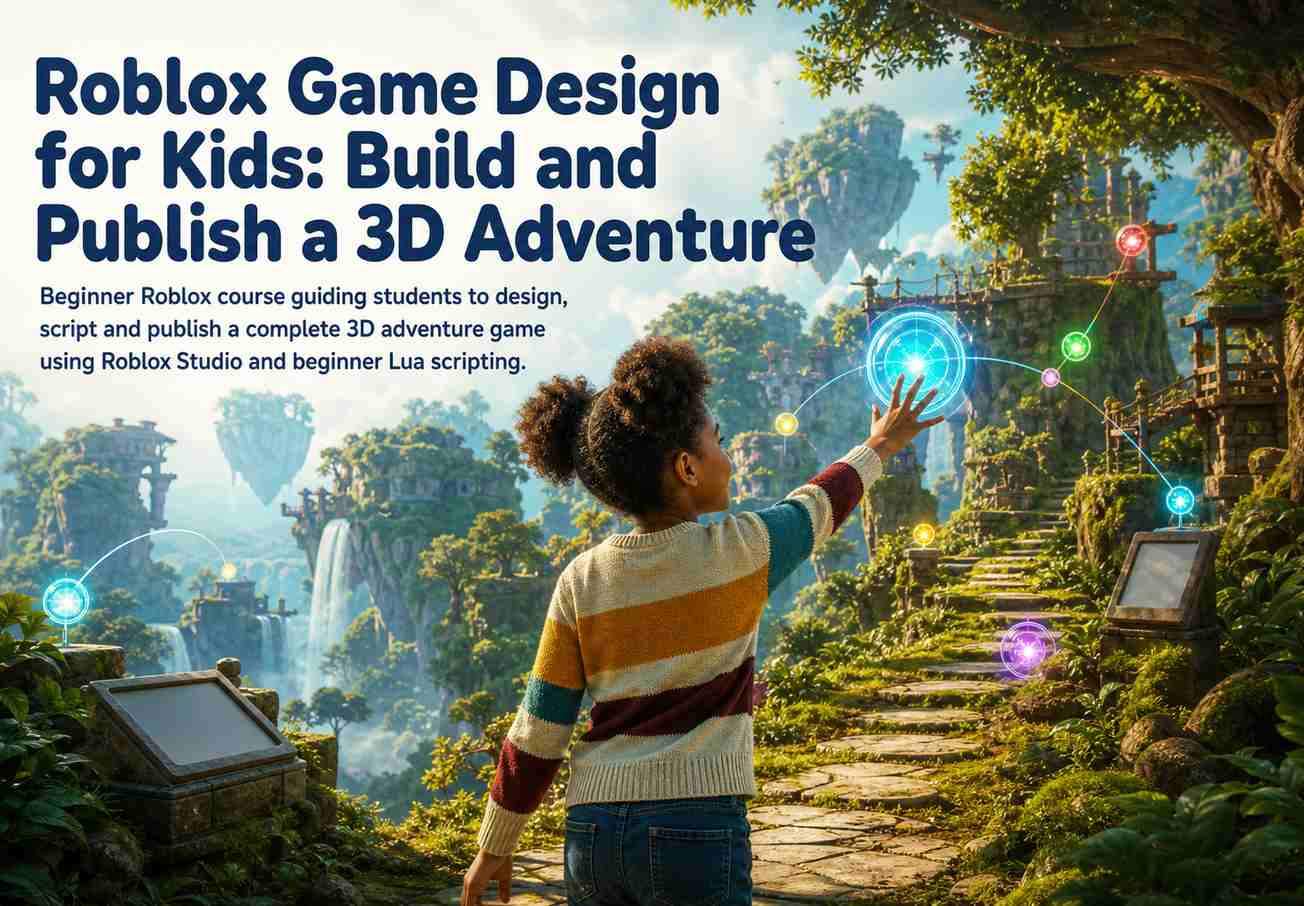
A first Studio project does not need code. Make a bedroom, a tiny island, a historical landmark, a café, a playground or one section of an imaginary city. Learn camera movement, parts, scale, color, terrain and object placement.
The goal is fluency: can the child make the digital space match an idea in their head?
Stage 2: build an obby
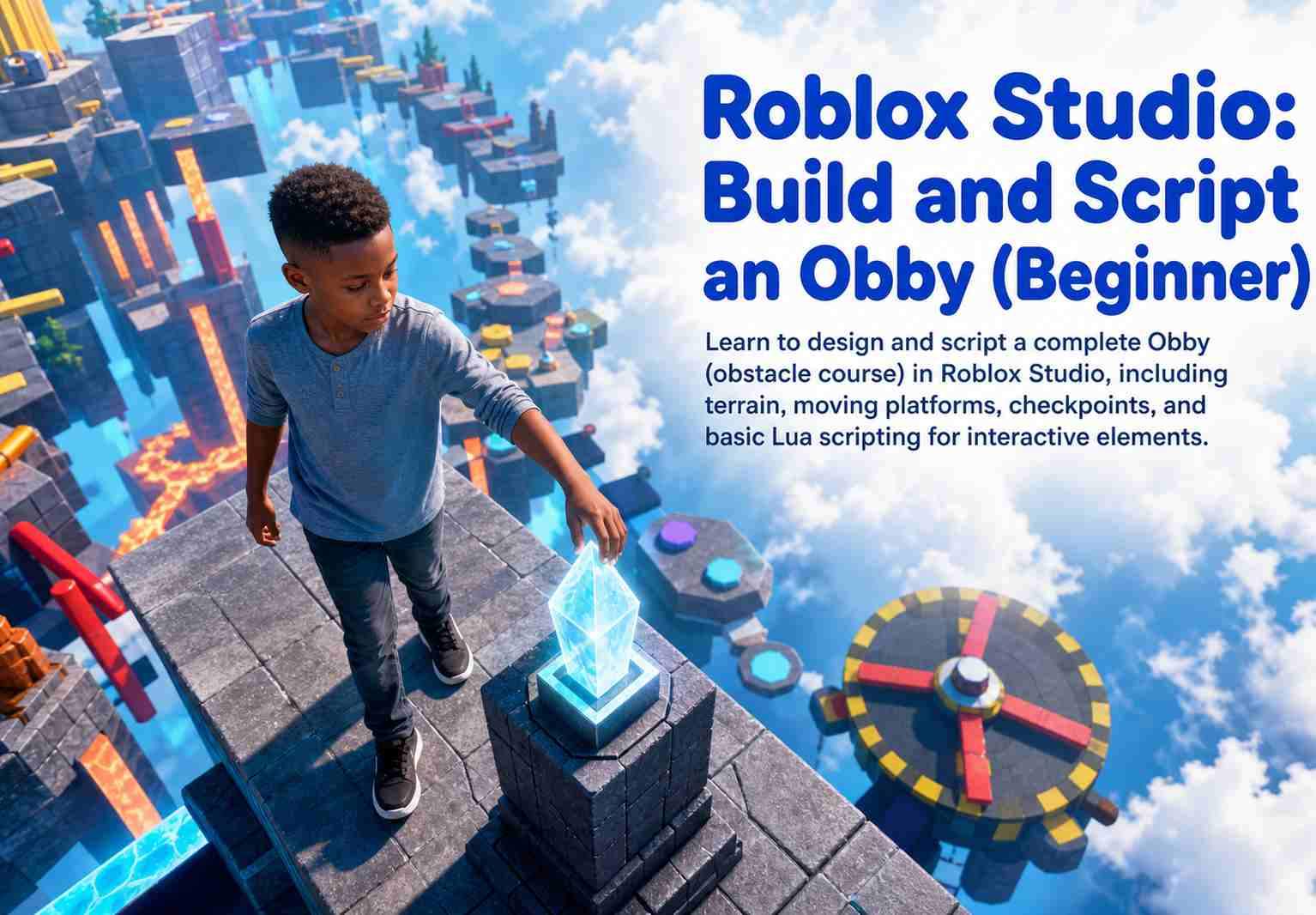
An obstacle course is almost perfect for beginners because it introduces level design without requiring a complicated story. The child must decide where the player starts, how difficulty rises, how jumps are communicated and what makes failure feel fair.
Then give it to somebody else without explaining. The playtester will expose assumptions immediately.
Stage 3: learn that game design is about the player
A beautiful environment is not automatically a good game. A game needs a loop: the player does something, receives feedback, makes another decision and understands progress.
Ask the child to describe that loop in their favorite Roblox experience. Then describe the loop in the game they are making.
Stage 4: add interaction
This is where code becomes useful. A door opens. A platform disappears. A player earns points. A trap responds to touch. An object changes state. The child now has a reason to learn variables, functions, events and conditions because those ideas make the world behave.
Stage 5: build for somebody else
The creator’s biggest cognitive shift is realizing that knowing how your own game works proves very little. A new player does not have your intentions in their head.
Watch a friend play without helping. Where do they hesitate? What do they misunderstand? Where do they quit? This is user research in a form a ten-year-old can understand.
Stage 6: finish something tiny
I would rather see a child publish one small, understandable, playable experience than spend six months talking about an enormous open-world game they never finish. Scope is a real development skill.
A finished tiny game teaches more about development than an unfinished dream game teaches about ambition.
Stage 7: learn scripting because the idea demands it
Roblox uses Luau, derived from Lua. The official Creator Hub teaches variables and objects, functions and events, conditionals, loops, tables and code organization. That is real programming. But the child does not need to begin by memorizing a language.
Start with “I want this bridge to disappear after three seconds.” The programming concept now has a job.
Stage 8: animation, UI, sound and 3D art
Some children discover that code is not their favorite part. That is not failure. Roblox creation includes level design, 3D modelling, interface design, animation, storytelling, sound and visual effects. Professional games are team products because these are distinct crafts.
Stage 9: publishing changes the standard
The moment another person can play the work, questions change. Does it load? Is the goal obvious? Does anything break? Is the difficulty fair? Is there content that should not be there? What happens on different devices?
Publishing should also trigger a safety and digital-citizenship conversation: public creation is different from making privately.
What about making money?
Roblox’s creator economy is real, which can make “make money with Roblox” extremely attractive. I would not make monetization the first objective for a child. First learn to make something people genuinely enjoy. Revenue systems introduced too early can distort the project toward extracting attention rather than developing craft.
A six-project creator ladder
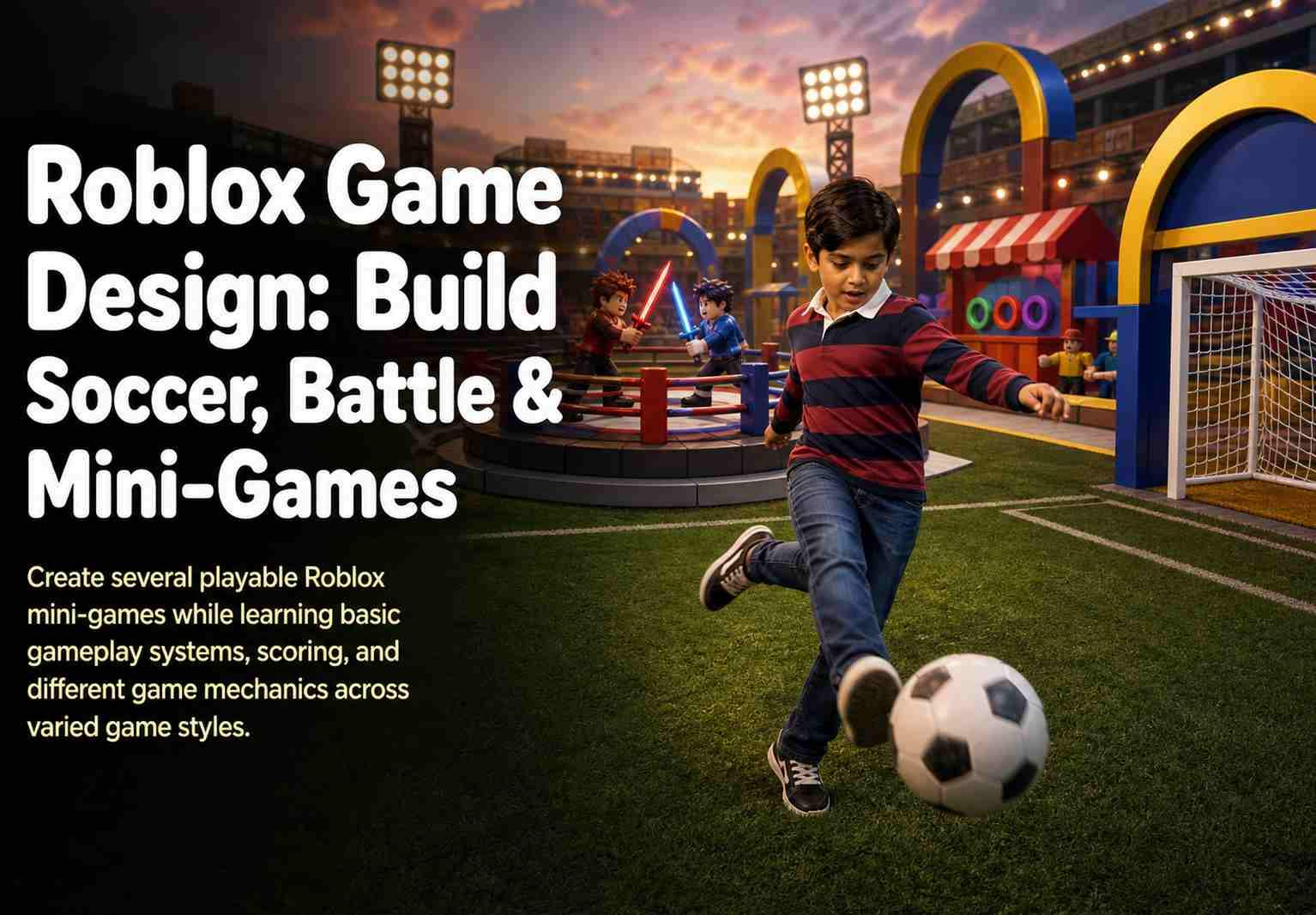
Build one room. Build an obby with five obstacles. Add one scripted mechanic. Create a tiny round-based game. Give it to three playtesters and redesign it. Build one original game around an idea the child invented rather than copied.
How to tell whether a Roblox class is actually good
Ask what percentage of the session the child creates rather than watches. Ask whether every child produces the same project. Ask how debugging is taught. Ask whether the child can explain their code. Ask how quickly students move from guided projects to original mechanics. Ask whether playtesting and iteration are part of the course.
A certificate tells you that a course ended. A playable game tells you much more about what the child can do.
The portfolio I would want at 13
Not twenty tutorial screenshots. I would want three small finished experiences: perhaps one polished obby, one mechanics-heavy game and one project showing the child’s strongest interest—animation, scripting, environmental art or game systems. Each should include a short explanation of the problem, what failed and what the child changed.
The destination
“I play Roblox” can become “I understand how games work,” then “I can make one,” and eventually “I can take an idea from my head and turn it into something another person can use.”
That final skill is much bigger than Roblox.
Further reading
These are not filler links. They are the sources I would actually open next: Roblox’s current documentation where platform details matter, and independent parent guidance where a second perspective is useful.
Official projects for Studio, building, animation, coding and complete game creation.
Roblox generally recommends Studio around age 10+, with younger learners often focusing on environment design.
Examples of educators using Roblox for coding, design thinking, entrepreneurship and interdisciplinary learning.