





Finding the Hook: Genre, Goal and Core Loop

Learners brainstorm game ideas, pick a genre and write a one-sentence hook and core loop describing what players do over and over.
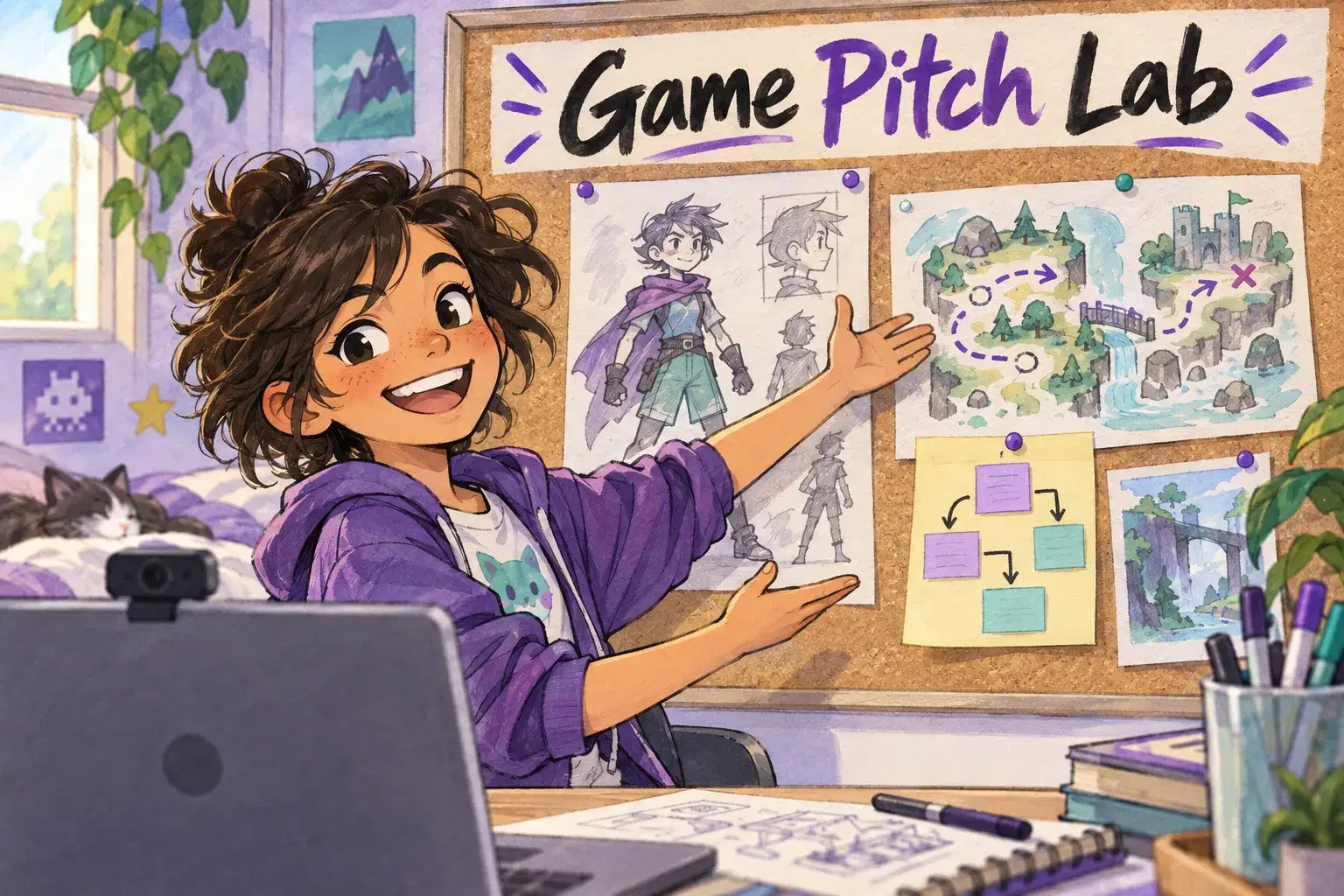
Tweens and teens design a dream video game entirely on paper, writing a game design document with characters, levels and mechanics, then deliver a polished pitch presentation to the class.
Paid once.
This course is all about thinking like a game designer before any code is written. Learners invent an original video game concept, define its genre and core loop, and decide what makes it different from games they already know.
Over four weeks they fill out a real-style game design document: a one-sentence hook, a hero and supporting characters, sketched level maps, controls and a reward system. Communication is a big focus, so learners also practise turning their ideas into a short, persuasive pitch with key art sketches, giving and receiving feedback before presenting their final pitch to the group.
The course meets once a week for four weeks, with 45-minute classes that build on each other. Each week adds a new section of the game design document, with short peer feedback rounds, and the final class is a pitch showcase where every learner presents their game.
Week 1: Finding the Hook: Genre, Goal and Core Loop – Learners brainstorm game ideas, pick a genre and write a one-sentence hook and core loop describing what players do over and over.
Week 2: Characters, World and Key Art Sketches – Learners design a hero, a rival or helper and the game world, sketching key art that shows the mood and style.
Week 3: Level Maps, Controls and Rewards – Learners map out a first level, list the controls and design rewards and challenges that keep players motivated.
Week 4: Pitch Day: Present Your Dream Game – Learners polish their game design document, rehearse a two-minute pitch and present it to the class for feedback.

Write a clear one-sentence hook and core gameplay loop
Design characters, a game world and key art sketches
Map a game level with controls, challenges and rewards
Organize ideas into a structured game design document
Deliver a confident, persuasive two-minute game pitch
No experience needed, and no coding is involved. Learners should be comfortable writing a few paragraphs. They need a device, a notebook or printer paper, pencils and colored pens for sketching.
The notebook holds the game design document, while paper, pencils and colored pens are for level maps and key art sketches.
A step-by-step plan of what your child learns, class by class. · 4 Weeks
Learners brainstorm game ideas, pick a genre and write a one-sentence hook and core loop describing what players do over and over.
Learners design a hero, a rival or helper and the game world, sketching key art that shows the mood and style.
Learners map out a first level, list the controls and design rewards and challenges that keep players motivated.
Learners polish their game design document, rehearse a two-minute pitch and present it to the class for feedback.
Next 7 days, US Eastern Time
No. This course is entirely on paper, and no coding or game software is used. Learners focus on the design thinking that comes before any code: ideas, characters, levels, rewards and how to explain the game to others. No experience is needed.
Each learner finishes with a complete game design document for their own video game idea, including a hook, core loop, characters, key art sketches, a level map, controls and rewards, plus a two-minute pitch they present to the class.
The course runs for four weeks with one 45-minute class per week. Each class adds a new section of the design document, so attending in order helps learners build a complete, well-organized game concept by pitch day.
Pitching is built up gradually. Learners first share short ideas in feedback rounds, then rehearse with a simple pitch structure before the final class. Notes and sketches can be held up while speaking, and the goal is a clear, friendly presentation rather than a perfect performance.
Learners are encouraged to take inspiration from games they enjoy, but the aim is an original concept with their own characters, world and twist. Thinking about what makes favorite games fun is part of the first class.
Possibly. The range of 10 to 14 is a flexible guide. A 9-year-old who writes a few paragraphs comfortably and can focus for 45 minutes may do well. Older teens who meet the prerequisites are welcome too.
Yes, about 15 to 20 minutes each week finishing that week's section of the design document, and rehearsing the pitch before the final class. There is no certificate. Learners keep their design document and pitch.
Cancel before the second class starts for a full refund. After that, classes already started count as used, and classes not yet started are refunded to store credit or your original payment method. On a weekly plan, cancelling stops future billing. You can cancel from the class in your parent dashboard.
Rahul is a warm, patient educator who helps young learners turn ideas into playable Scratch projects. With a focus on game design, animation, and interactive storytelling, he leads weekly club sessions and short workshops that teach sprites, movement, conditionals, loops, collisi…
Mrs. D.
Club · Ages 7–10 · 30 min · 1 / Week
$15.00per classSee schedule
Diya D.
Ages 6–8 · 30 min · 1 / Week
$19.00per classSee schedule
Ishita N.
Ages 8–12 · 55 min · 1 / Week
$20.00per classSee schedule

Ishita N.
Ages 8–12 · 55 min · 5 / Week
$20.50per classSee schedule
Aarohi M.
Ages 8–12 · 55 min · 1 / Week
$20.50per classSee schedule
Tanvi G.
Ages 7–11 · 55 min · 1 / Week
$20.00per classSee schedule
Aman G.
Ages 8–12 · 55 min · 1 / Week
$20.00per classSee schedule
Aarohi M.
Ages 8–12 · 55 min · 1 / Week
$20.50per classSee schedule
Mrs. D.
Beginner
Level
7–10
Ages
30 min
Duration
1 / Week
Classes
Ongoing
Weeks
Diya D.
Beginner
Level
6–8
Ages
30 min
Duration
1 / Week
Classes
1
Weeks
Ishita N.
Beginner
Level
8–12
Ages
55 min
Duration
1 / Week
Classes
4
Weeks
Ishita N.
Beginner
Level
8–12
Ages
55 min
Duration
5 / Week
Classes
1
Weeks
Aarohi M.
Beginner
Level
8–12
Ages
55 min
Duration
1 / Week
Classes
4
Weeks
Tanvi G.
Beginner
Level
7–11
Ages
55 min
Duration
1 / Week
Classes
1
Weeks
Aman G.
Beginner
Level
8–12
Ages
55 min
Duration
1 / Week
Classes
1
Weeks
Aarohi M.
Beginner
Level
8–12
Ages
55 min
Duration
1 / Week
Classes
8
Weeks