




Design a Snow Plow Blade

Meet the engineering design process, sketch a plow and build a cardboard blade that pushes rice or cotton-ball snow.
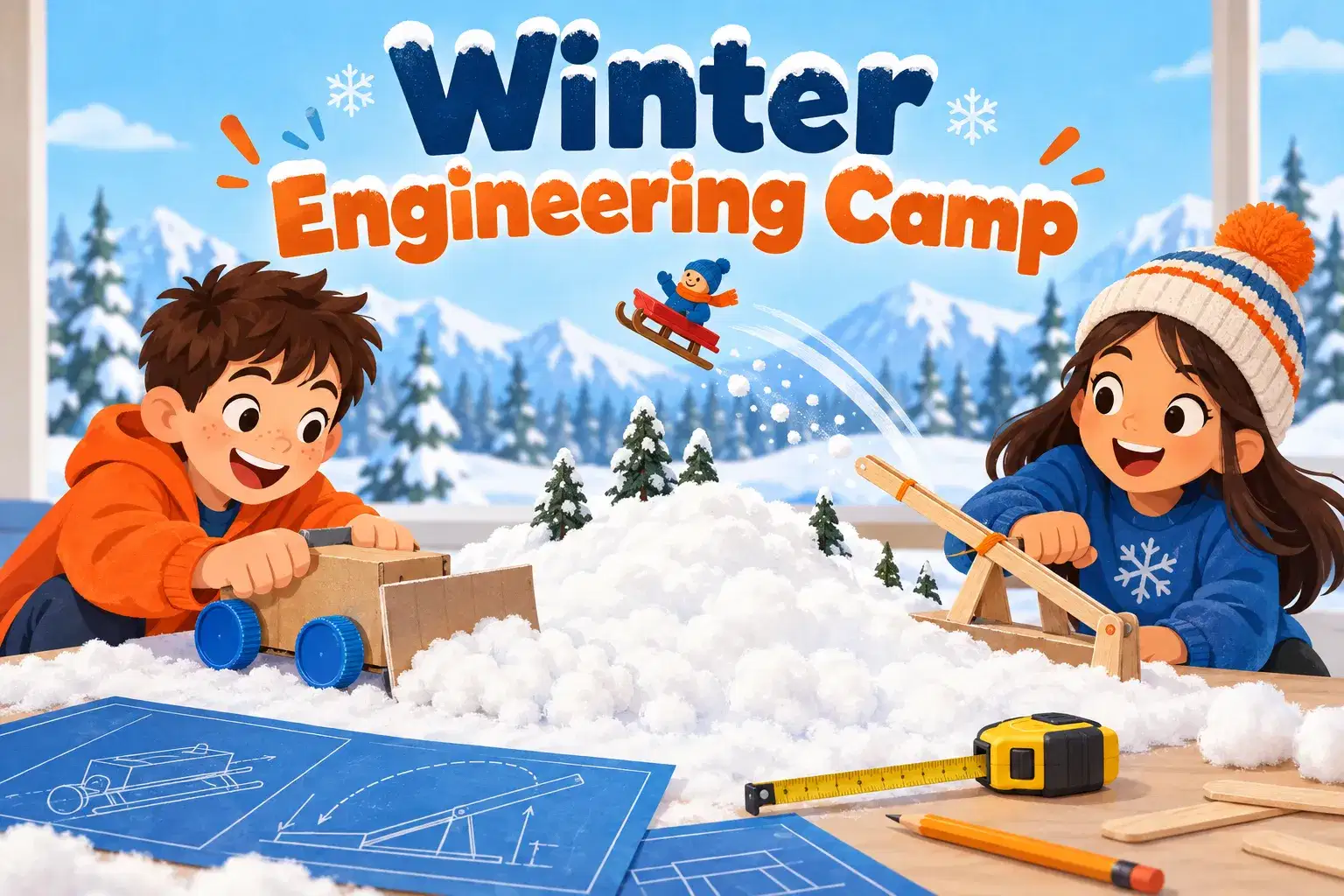
A four-day winter engineering camp where kids design, build and test a cardboard snow plow and a rubber-band sled launcher. Learners use the engineering design process, simple machines and fair tests to improve their builds each day.
$80.00
4 classes · $20.00 per class
Paid once.
What does it take to clear a snowy road or launch a sled down a hill? In this four-day winter camp, young engineers answer those questions by building two working prototypes from household materials: a cardboard snow plow that pushes "snow" and a rubber-band sled launcher that sends a mini sled flying.
Each day follows the engineering design process real engineers use: ask, imagine, plan, build, test and improve. On day one learners sketch and build a plow blade and test how much rice or cotton-ball snow it can move. Day two adds wheels and axles so the plow rolls. On day three they switch to a sled launcher, using a craft-stick lever and rubber bands to store and release energy. The final day is all about fair tests, measuring results and making one smart improvement to each build.
The teacher builds alongside learners on camera, explains the science in kid-friendly language and helps troubleshoot when a wheel wobbles or a lever will not fire. Learners compare designs, share ideas and learn that a build that fails a test is simply the next step toward a better one.
By the end of camp, each learner has two winter-themed prototypes, a simple test record and a clear understanding of levers, wheels and axles and how engineers improve designs.
Classes begin with a short challenge and demo, followed by guided building time with the teacher checking each learner's progress. Every class ends with a test round where learners share results and plan their next improvement.
Day 1: Design a Snow Plow Blade – Meet the engineering design process, sketch a plow and build a cardboard blade that pushes snow.
Day 2: Wheels and Axles – Add straw-and-skewer axles so the plow rolls, then test how far it pushes snow.
Day 3: Build a Sled Launcher – Use a craft-stick lever and rubber bands to launch a mini sled and measure the distance.
Day 4: Test, Improve and Showcase – Run fair tests, make one improvement to each build and present the results.

Use the engineering design process to plan, build and improve a prototype
Explain how wheels and axles reduce friction
Use a lever and rubber bands to store and release energy
Run a fair test and record measurements
Present a design and explain one improvement
No engineering experience needed. Learners should be able to use scissors and tape on their own; a grown-up may help with poking skewer holes in cardboard.
Recycled cardboard (cereal boxes work well); 10 craft sticks; 6 rubber bands; 4 straws; 2 wooden skewers; 4 bottle caps for wheels; masking tape; scissors; a cup of rice or a bag of cotton balls as snow; ruler or tape measure; printed test sheet.
A step-by-step plan of what your child learns, class by class. · 1 Week
Meet the engineering design process, sketch a plow and build a cardboard blade that pushes rice or cotton-ball snow.
Add straw-and-skewer axles so the plow rolls, then test how far it pushes snow with one push.
Use a craft-stick lever and rubber bands to launch a mini sled and measure the distance.
Run fair tests, make one improvement to each build and present the results to the group.
Next 7 days, US Eastern Time
It suits curious kids aged 8 to 12 who like building and testing things. No engineering experience is needed, only the ability to cut and tape on their own.
Recycled cardboard, craft sticks, rubber bands, straws, wooden skewers, bottle caps, tape, scissors, a ruler and some rice or cotton balls as snow. A full list is shared before Day 1 so you can gather everything in advance.
The teacher shares the day's build steps so your child can finish at home. Each day starts with a quick recap, so they can rejoin the next build without falling behind.
Two working winter prototypes, a cardboard snow plow and a rubber-band sled launcher, plus a simple test record. They will also be able to explain how levers, wheels and axles help their builds work.
Yes. It launches a small paper or cardboard sled a short distance using rubber bands. The teacher explains simple safety rules, such as always aiming away from people.
They have 17 years of fifth-grade science teaching experience and served as a STEM and math-and-science instructional coach. They led professional development, supported teachers, and developed hands-on engineering and STEM units. Their lessons have students explore engineering d…
Sonia K.
Ages 7–10 · 45 min · 4 / Week
$19.00per classSee schedule

Tapati N.
Ages 6–9 · 45 min · 1 / Week
$20.00per classSee schedule
Tapati N.
Club · Ages 6–8 · 40 min · 1 / Week
$15.00per classSee schedule

Nandini S.
Club · Ages 15–17 · 75 min · 1 / Week
$28.00per classSee schedule
Kokila M.
Ages 3–5 · 25 min · 2 / Week
$15.00per classSee schedule
Ms. S.
Ages 4–6 · 30 min · 1 / Week
$20.00per classSee schedule
Sneha P.
Ages 10–15 · 60 min · 1 / Week
$30.00per classSee schedule
Krishna C.
Ages 4–6 · 30 min · 1 / Week
$15.00per classSee schedule
Sonia K.
Mixed Level
Level
7–10
Ages
45 min
Duration
4 / Week
Classes
1
Weeks
Tapati N.
Beginner
Level
6–9
Ages
45 min
Duration
1 / Week
Classes
1
Weeks
Tapati N.
Mixed Level
Level
6–8
Ages
40 min
Duration
1 / Week
Classes
Ongoing
Weeks
Nandini S.
Advanced
Level
15–17
Ages
75 min
Duration
1 / Week
Classes
Ongoing
Weeks
Kokila M.
Beginner
Level
3–5
Ages
25 min
Duration
2 / Week
Classes
2
Weeks
Ms. S.
Beginner
Level
4–6
Ages
30 min
Duration
1 / Week
Classes
4
Weeks
Sneha P.
Intermediate
Level
10–15
Ages
60 min
Duration
1 / Week
Classes
6
Weeks
Krishna C.
Beginner
Level
4–6
Ages
30 min
Duration
1 / Week
Classes
1
Weeks