By Cole Winters ·
Why Kids Struggle With Fractions
Why fractions feel hard for many kids—and what parents can practice so understanding sticks beyond memorized steps.
Why Does My Child Struggle With Fractions?
Fractions expose whether a child understands quantity, equivalence and operations—or has been following whole-number rules that no longer work.
Fractions are a turning point in elementary and middle-grade math. They ask a child to treat a number as a relationship—parts relative to a whole—rather than as a simple count of objects. When earlier success came from whole-number habits, fraction units can suddenly feel unfair: the same digits behave differently, familiar addition rules break and “bigger bottom number” no longer means “bigger amount.” Struggle here is common and usually informative.
Fractions require a new idea of number
A fraction is one number describing a relationship, not two whole numbers stacked. Children need to see fractions as quantities located on a number line, not only as pizza slices on a worksheet. Until that shift happens, procedures float on top of confusion.
Talk about how large the piece is, how many pieces there are and what whole they come from. Those three ideas—part size, number of parts and the whole—must stay coordinated. When any one of them slips, errors multiply even if the child can recite a rule.
Common misconceptions
Children may think larger denominators mean larger fractions, add numerators and denominators separately, ignore the whole or apply a rule without knowing why. These errors are useful evidence, not proof that the child “just isn’t a math kid.”
Listen to the explanation. A child who says three-eighths is bigger than three-fourths because eight is bigger than four is applying whole-number magnitude to the wrong place. A child who adds one-half and one-third to get two-fifths is treating the fraction bar as a separator rather than a relationship. Correct the idea with a model before drilling the algorithm again.
| Misconception | What it reveals | Repair focus |
|---|---|---|
| Bigger denominator = bigger fraction | Whole-number thinking | Equal wholes; number line |
| Add tops and bottoms | Procedure without meaning | Common-sized parts |
| Ignores the whole | Unstable unit | Define the whole every time |
| Rule without why | Fragile memory | Models before algorithms |
Return to models
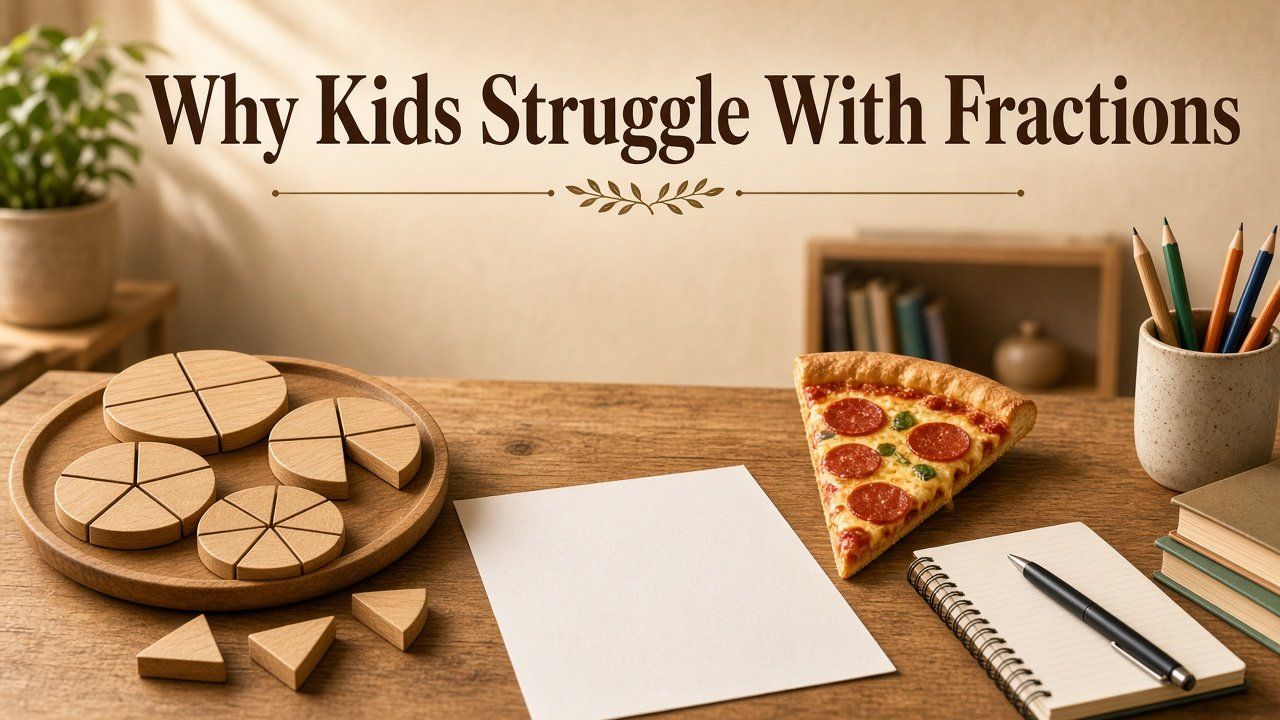
Use fraction strips, area models and number lines. Compare three-fourths and three-eighths with equal wholes so the child can see that more pieces of a whole can mean smaller pieces. Build equivalent fractions physically before using multiplication rules.
Fraction strips, circles, measuring cups and number lines can all help when they are linked explicitly to notation. The manipulative alone is not the lesson; the connection between the model and the written fraction is. Ask the child to write what the model shows and to build what a written fraction means.
Connect representations
Ask the child to move among a picture, fraction, decimal, percent and real situation. Flexible representation is stronger than success on one worksheet format. A child who can only shade circles may still stall on a number-line comparison or a recipe problem.
Keep the same quantity and change the clothing it wears: three-fourths of a pan, 0.75, 75 percent, a point on a number line. When the child recognizes sameness across forms, fraction sense is beginning to stabilize.
Teach operations through meaning
For addition, explain why units need common-sized parts. For multiplication, use “a fraction of.” For division, ask how many groups fit. Algorithms should summarize reasoning, not replace it. Teaching cross-multiplication early can hide misconceptions if comparison and equivalence are not yet visual and solid.
When a procedure appears, ask the child to explain it with a model or a story. If they can only recite steps, slow down. Speed on worksheets without meaning tends to collapse the first time the problem looks unfamiliar.
Procedures without meaning can hide misconceptions. Build comparison and equivalence visually first.
Practice estimation
Before calculating, ask whether the result is less than one, near one or greater than one. Estimation catches many rule-based errors. A child who claims one-half plus two-thirds equals three-fifths can often see the mistake when asked whether the sum should be more than one.
Make estimation a habit, not a rare extension. Thirty seconds of “about how big?” before the pencil starts can protect a child from confidently writing nonsense produced by a misapplied rule.
Identify the prerequisite
Weak multiplication facts, division, factors or place value can complicate fraction work. Repair the smallest missing piece and return to the target problem. Spending months on fraction drills while multiplication fluency is shaky often creates new frustration without fixing the root.
After a short prerequisite repair, go back to the fraction task that originally failed. The child needs to feel that the missing piece was worth fixing because it unlocked the goal—not that math is an endless sequence of detours.
Use unfamiliar examples
Worksheet success on identical formats can look like mastery while understanding remains thin. Change the story, the model and the numbers. Ask the child why a method works, not only what the next step is.
Fractions are hard because they challenge whole-number intuitions and require coordinating part size, number of parts and the whole. That difficulty is real—and it is also why careful models, estimation and meaning-first operations pay off far more than another round of memorized tricks.
Frequently asked questions
They challenge whole-number intuitions and require coordinating part size, number of parts and the whole.
Procedures without meaning can hide misconceptions. Build comparison and equivalence visually first.
Fraction strips, circles, measuring cups and number lines can all help when linked explicitly to notation.
Sources and review note
Product features, prices and safety settings can change. Check official provider information before purchasing or enabling online access. Educational and health concerns should be discussed with qualified professionals familiar with your child. This article is educational and does not replace medical or individualized educational advice.