By Isla Moreau ·
Minecraft for Education: The Complete Parent Guide
What Minecraft Education actually teaches, how it differs from ordinary play, which subjects it suits, and how parents can tell when the learning is real.
Minecraft for Education: The Complete Parent Guide
What Minecraft Education actually teaches, how it differs from ordinary play, which subjects it suits, and how parents can tell when the learning is real.
Minecraft is one of those rare products that can be a toy, a social space, a design tool, a programming environment and a classroom. That is exactly why parents get confused about its educational value. A child can spend two hours in Minecraft and learn almost nothing new—or spend the same two hours planning, measuring, negotiating, debugging, researching and redesigning.
The important question is not “Is Minecraft educational?” It is: What role is the child playing, what problem are they solving, and what are they doing with what they discover?
What Minecraft Education actually adds
Minecraft Education is not simply regular Minecraft with worksheets. It includes teaching-oriented features, a large standards-aligned lesson library, classroom collaboration tools, coding pathways and curated worlds across science, mathematics, language arts, social studies and computer science. The official platform says it offers more than 600 standards-aligned lessons and is used across more than 40,000 school systems in 140 countries.
That scale is context, not proof that every Minecraft lesson is excellent. The real strength is that a familiar three-dimensional environment can turn an abstract idea into something a child must build, test, represent, explain or negotiate.
The learning model I would use
Play creates motivation and fluency. Purpose turns the activity into a challenge. A constraint forces choices. Creation makes the child produce something. Feedback exposes weak thinking. Reflection helps transfer the learning beyond the game. Without those middle steps, “educational Minecraft” can collapse back into ordinary entertainment with an educational label.
What subjects can Minecraft genuinely support?
Science
Children can model ecosystems, compare renewable-energy choices, design structures, investigate food systems, represent biological processes or build solutions to environmental problems. The game is especially useful when the learning involves systems, space, relationships and cause-and-effect.
Mathematics
Coordinates, scale, perimeter, area, volume, ratios, symmetry, budgeting and optimization are natural fits because Minecraft is made of countable units in a three-dimensional coordinate space. Mathematics becomes stronger when the build has to meet a specification rather than simply look attractive.
Social studies
Recreating an ancient settlement is only the first layer. A better task asks why the settlement was located there, how people obtained water, what trade routes mattered, how architecture reflected technology and culture, and what changed over time. Minecraft Education’s official social-studies collection includes history, civics, economics, cultures and civilization-focused build challenges.
Computer science
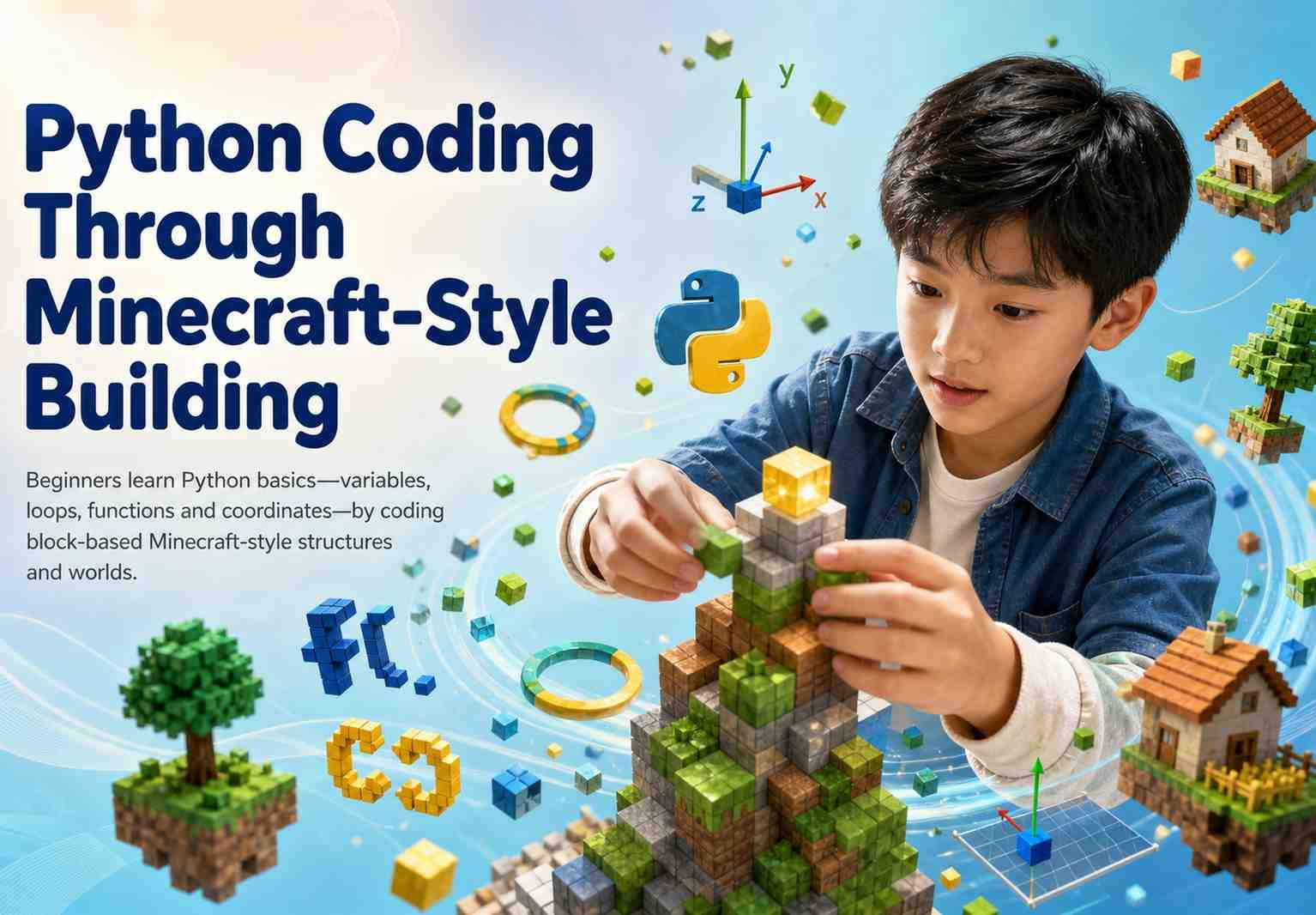
This is one of the clearest structured pathways. Minecraft Education supports MakeCode Blocks and Python, and its current computer-science hub includes coding, AI literacy, cybersecurity and game design. Children can move from controlling the Agent with sequences to loops, variables, functions and Python.
Language arts
A child can build a setting from a novel, stage a scene, create a character’s home, produce a virtual museum or design an interactive story world. The strongest tasks require the child to justify design decisions with evidence from the text.
Minecraft is particularly good at making systems visible
A textbook can tell a child that cities need water, transport, housing and energy. Minecraft can force them to discover that those systems compete for limited space and resources. A beautiful city is easy. A city that works under constraints is harder.
“Build a city for 500 residents using limited land, renewable energy, public transport and flood protection” is a systems challenge.
The difference between a build and a learning task
A build becomes educationally deeper when the child must explain a decision, compare alternatives, test whether something works, respond to feedback or revise under a new condition. Add even one of those and ordinary building moves toward design thinking.
For example, “build a bridge” becomes: span 20 blocks, use no more than 100 blocks, support a minecart route and explain why you chose the structure. Now the child has constraints, measurement and trade-offs.
What ages does this work for?
Younger children can use Minecraft primarily for storytelling, spatial reasoning and purposeful building. Around eight to ten, constraints, measurement, simple collaboration and introductory coding can become more meaningful. From roughly eleven onward, the platform can support increasingly sophisticated programming, systems modelling, history simulations and longer team projects. These are not gates; reading, typing, executive function, game fluency and interest matter more than birthdays.
The parent mistake I would avoid
Do not hijack every Minecraft session. If a child loves Minecraft, turning every visit into “now let’s learn fractions” is a reliable way to make both fractions and Minecraft less attractive. Keep ordinary play. Add occasional challenges that open new doors.
Use the game as a doorway into deeper thinking, not as camouflage for a worksheet.
What I would look for after a good session
Can the child explain what they were trying to achieve? Can they describe one failure or trade-off? Did they make decisions rather than merely follow steps? Could they show evidence for a claim? Did they revise something after feedback? Can they connect the game idea to something outside the game?
A simple home progression
Stage 2: Build it under a constraint.
Stage 3: Build it for another person.
Stage 4: Test whether it actually works.
Stage 5: Explain what you changed and why.
Where Minecraft Education is strongest
It is strongest when a topic benefits from simulation, spatial modelling, collaboration or creation. It is weaker when the learning goal is simply memorising isolated facts. The game should do something paper cannot do easily: make a system explorable, make an idea buildable, or make a team negotiate a shared world.
The bigger thesis
Minecraft does not magically produce those outcomes. But it provides a remarkably flexible environment in which children can practise them if the challenges are designed well.
Further reading and source material
These are the sources I would open next if I wanted to go deeper. Wherever possible, they are official Minecraft Education resources rather than generic roundups.
Official overview of teaching features, cross-curricular content and real-world skill building.
Official lesson library across computer science, maths, science, language arts and social studies.
Official coding pathway from MakeCode Blocks through Python, AI literacy, cybersecurity and GameCode.
Official history, culture, civics, economics and civilization resources.
Ten-lesson Python sequence covering syntax, variables, conditionals, loops, lists and functions.