





World-Building: Setting, Mood and Big Mystery

Learners create the place where their adventure happens, map key locations and write a hook that makes players want to explore.
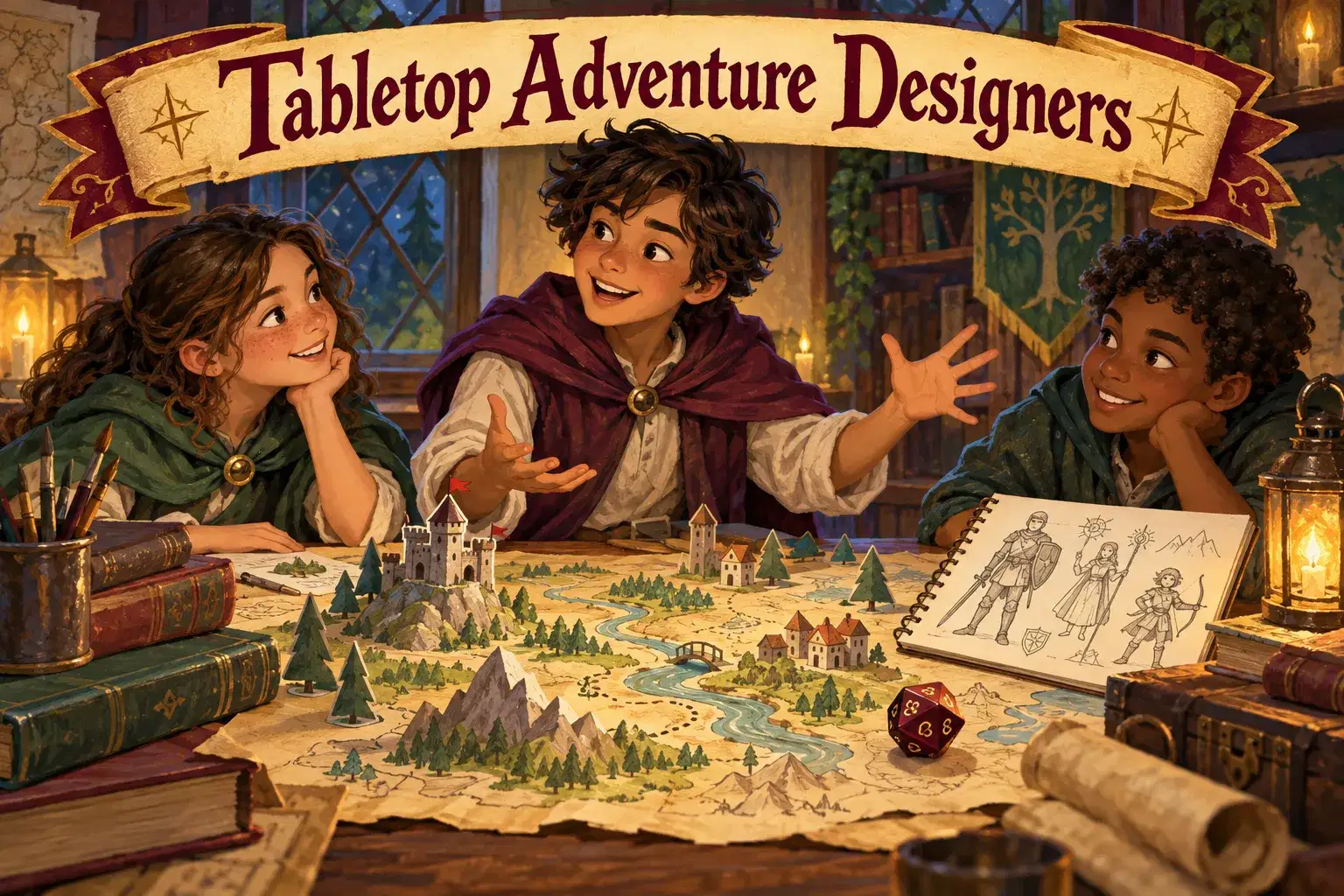
Teens design and run their own tabletop role-playing adventure, creating a world, character sheets, a simple dice system and a quest, then pitch it and guide classmates through a live playtest.
Paid once.
In this six-week course, learners move beyond playing role-playing games to designing one. They invent a setting, from a floating island city to a haunted library, and build the pieces that make an adventure work: character choices, a fair dice or card system for actions, and a quest with puzzles, choices and friendly or tricky characters to meet.
Teamwork and communication are at the heart of it. Learners trade ideas in small discussions, test each other's rules, and practise being a game leader who describes scenes clearly and keeps every player involved. They finish with a short game design document and a pitch for their adventure.
The course meets once a week for six weeks, with each 55-minute class building on the last. Learners design a new piece of their game every week, try it out with classmates in short playtests, and refine it before the final session where they pitch and run their adventure.
Week 1: World-Building: Setting, Mood and Big Mystery – Learners create the place where their adventure happens, map key locations and write a hook that makes players want to explore.
Week 2: Character Sheets and Player Choices – Teens design a character sheet with traits and abilities so players can make meaningful, balanced choices for their heroes.
Week 3: Dice, Cards and Fair Action Rules – Learners build a simple system for deciding success or failure, then test whether it feels fair, exciting and quick to use.
Week 4: Quest Design: Puzzles, Choices and Allies – Teens plan a three-scene quest with a puzzle, a tough decision and helpful or tricky characters players can talk to.
Week 5: Leading the Table: Narrating and Teamwork – Learners practise describing scenes, responding to player ideas and keeping everyone included, then run a short scene with classmates.
Week 6: Adventure Pitch and Live Playtest Showcase – Teens present their design document, pitch their world and guide classmates through a short playtest of their quest.

Design a game world with locations, mood and a mystery
Create balanced character sheets with meaningful player choices
Build and test a fair dice or card action system
Write a short game design document for an adventure
Lead a group playtest by narrating and including every player
Learners should have played at least one board, card or role-playing game and be able to follow and explain its rules. They need a device, paper or a notebook, pencils and a standard six-sided die or two.
The notebook holds the world map and design document, index cards become character sheets and quest cards, and dice drive the action rules.
A step-by-step plan of what your child learns, class by class. · 6 Weeks
Learners create the place where their adventure happens, map key locations and write a hook that makes players want to explore.
Teens design a character sheet with traits and abilities so players can make meaningful, balanced choices for their heroes.
Learners build a simple system for deciding success or failure, then test whether it feels fair, exciting and quick to use.
Teens plan a three-scene quest with a puzzle, a tough decision and helpful or tricky characters players can talk to.
Learners practise describing scenes, responding to player ideas and keeping everyone included, then run a short scene with classmates.
Teens present their design document, pitch their world and guide classmates through a short playtest of their quest.
Next 7 days, US Eastern Time
They should have played at least one board, card or role-playing game and be able to explain how its rules work. They do not need to have led a game before. We teach game-leading skills in week five, after the world, characters and rules are built.
Each learner finishes with an original tabletop adventure: a world map, character sheets, a simple dice or card system and a three-scene quest. These come together in a short game design document, which they pitch before guiding classmates through a live playtest.
The course runs for six weeks with one 55-minute class each week. Every class adds a new part of the game, so attending in order matters. The final class is the showcase, where learners pitch and run a short playtest of their adventure.
No. Quests in this course focus on exploring, solving puzzles, making choices and talking with characters. Learners are guided to design adventures that are suitable for all ages, and themes like mysteries, rescues and treasure hunts work especially well.
Learners design their own adventure but test it with others. Classmates act as players during short playtests, give feedback on rules and characters, and learn to take turns as both game leader and player. That collaboration is where most of the improvements happen.
Yes, they may be a good fit. The range of 11 to 14 is a flexible guide. A 10-year-old who meets the prerequisites, enjoys writing and is comfortable discussing ideas in a group for 55 minutes would likely do well.
Yes. Expect about 15 to 20 minutes a week finishing that week's design piece, such as a character sheet or quest scene, so class time can go to testing. There is no certificate. Learners keep their full design document and game.
Cancel before the second class starts for a full refund. After that, classes already started count as used, and classes not yet started are refunded to store credit or your original payment method. If you are on a weekly plan, cancelling stops future billing. Cancel from the class in your parent dashboard.
Tanya blends playful creativity with methodical engineering practice to teach 3D modeling to younger learners. With nine years designing project-based Tinkercad curricula, she leads guided builds—Minecraft-style characters, wearables, props, mini cities, and tabletop toys—teachin…
Rahul P.
Ages 10–14 · 45 min · 1 / Week
$19.00per classSee schedule
Nisha V.
Ages 7–11 · 30 min · 1 / Week
$16.00per classSee schedule

Raj K.
Ages 8–12 · 30 min · 4 / Week
$16.00per classSee schedule
Philomena N.
Ages 5–7 · 30 min · 1 / Week
$17.00per classSee schedule
Nandini K.
Ages 8–12 · 45 min · 4 / Week
$18.00per classSee schedule
Avni K.
Ages 12–16 · 50 min · 4 / Week
$20.00per classSee schedule
Harshita R.
Intermediate
Level
9–13
Ages
45 min
Duration
1 / Week
Classes
6
Weeks
Rahul P.
Beginner
Level
10–14
Ages
45 min
Duration
1 / Week
Classes
4
Weeks
Nisha V.
Beginner
Level
7–11
Ages
30 min
Duration
1 / Week
Classes
1
Weeks
Raj K.
Beginner
Level
8–12
Ages
30 min
Duration
4 / Week
Classes
1
Weeks
Anne M.
Beginner
Level
7–10
Ages
30 min
Duration
1 / Week
Classes
Ongoing
Weeks
Philomena N.
Beginner
Level
5–7
Ages
30 min
Duration
1 / Week
Classes
4
Weeks
Nandini K.
Beginner
Level
8–12
Ages
45 min
Duration
4 / Week
Classes
1
Weeks
Avni K.
Beginner
Level
12–16
Ages
50 min
Duration
4 / Week
Classes
1
Weeks