By Amelia ·
Minecraft Halloween Adventure Ideas for Kids
Turn a child’s love of Minecraft into Halloween building, storytelling, and group challenges with practical prompts for ages 7–12.
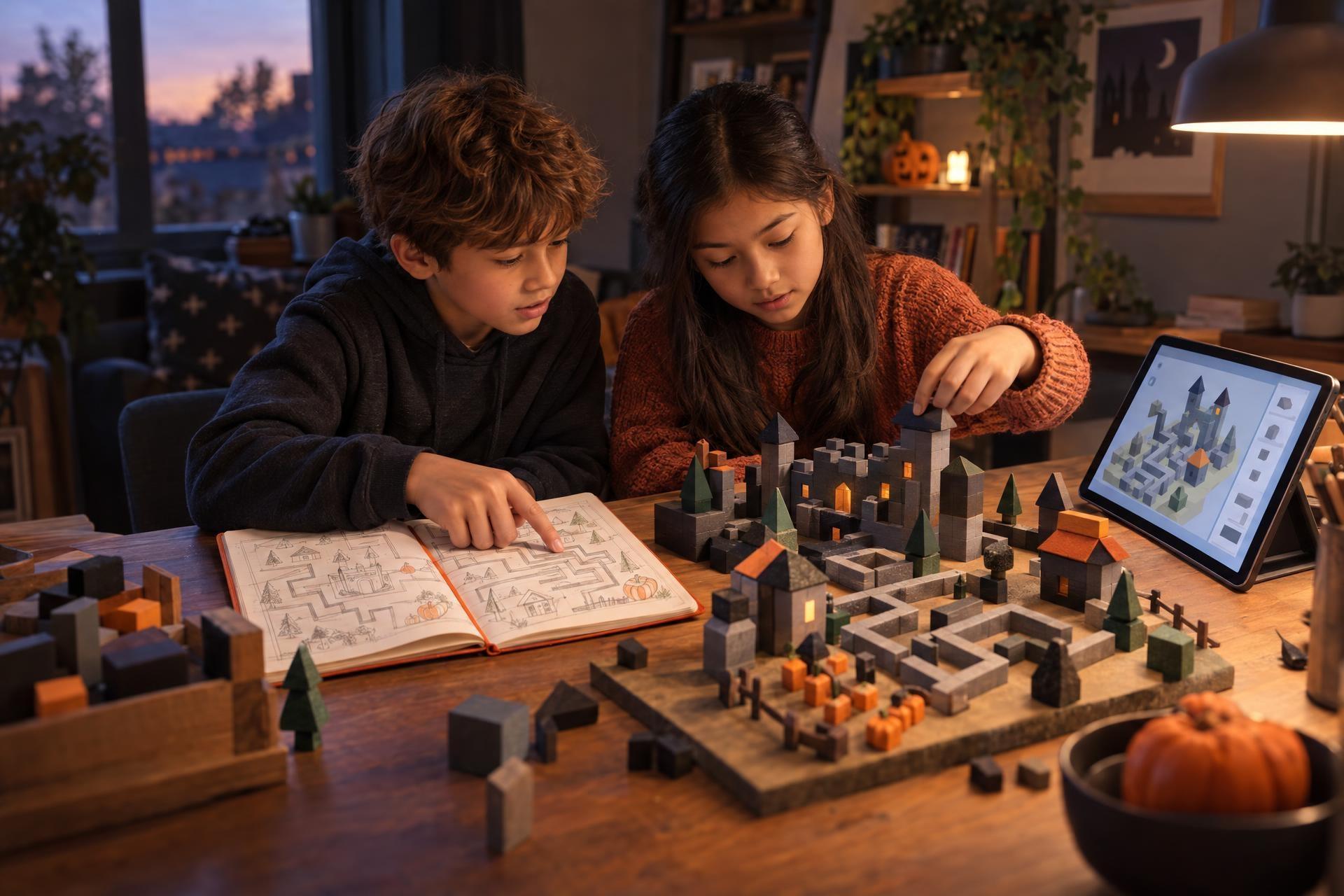
If your child already spends time imagining worlds in Minecraft, Halloween can offer a particularly inviting prompt: build somewhere spooky, give visitors a reason to explore it, and decide what happens next. The value is not in proving that a favorite game is secretly schoolwork. It is in giving a child a familiar creative language for making something more intentional—on their own, with friends, or in a guided group activity.
Minecraft-themed Halloween activities can start with what a child already enjoys: building, decorating, exploring, and inventing. A simple prompt—such as a haunted house with a hidden route or a village preparing for trick-or-treaters—can invite design choices, revision, and storytelling. For children who like working with others, a shared build can also create practical moments to divide roles and combine ideas. The best fit depends on the child: some will want to narrate the mystery, while others will happily spend an hour perfecting a pumpkin patch or maze entrance.
Why Halloween is a natural building prompt
Open-ended games can sometimes leave a child with too many possibilities. A seasonal theme gives the blank canvas a little shape without dictating every decision. “Build something Halloween-related” is broad enough for imagination, but specific enough to get a project moving.
A child might choose a creaky mansion, a friendly monster café, a moonlit pumpkin farm, a costume shop, or a trick-or-treat village connected by winding paths. None of these ideas needs to be scary. Halloween builds can be mysterious, silly, cozy, dramatic, or all four at once.
More importantly, a themed prompt gives the builder useful questions to answer. Who comes here? Where do they enter? What should they notice first? How will they know where to go? Those questions naturally turn decoration into a place with a purpose.
The goal is not to make every minute of Minecraft productive. A Halloween challenge simply gives interested children one more way to move from consuming a familiar world to actively creating and sharing one.
Five Halloween build ideas that invite real decisions
The most engaging prompts leave room for a child’s own taste. Rather than asking for the “best” haunted house, ask for a place that a visitor can understand, explore, and remember.
| Build prompt | Creative decisions it can invite | Optional story twist |
|---|---|---|
| Haunted mansion | Plan rooms, entrances, surprises, and a route through the house. | The owner has disappeared, and visitors must find three clues. |
| Pumpkin patch and farm | Create a layout, landmarks, signs, and a harvest-day atmosphere. | One pumpkin holds the key to helping a lost ghost get home. |
| Mystery maze | Balance dead ends, shortcuts, clues, and clear landmarks. | The exit only appears after visitors solve a riddle. |
| Trick-or-treat village | Give each building a purpose and connect the town with walkable paths. | Each housekeeper has a piece of a larger town mystery. |
| Costume shop | Design displays, a workshop, and costumes for different characters. | A costume changes its wearer’s voice—but only until midnight. |
A strong prompt often includes one small constraint. For example: the mansion must have two routes, but only one leads to the library; the maze needs a landmark visible from several paths; or every house in the village must offer a different clue. Constraints are not there to make a build feel like an assignment. They give children something interesting to solve.
The 15-minute Halloween build brief
Before a child begins, invite them to choose a setting, a visitor, and one problem. “My setting is a pumpkin village. The visitor is a witch looking for a missing recipe. The problem is that the clues are hidden in three shops.” That short brief is enough to guide a build while keeping ownership with the child.
Make the build into a story, not just a scene
A detailed build can be satisfying on its own. But for many children, a story gives all those rooms, paths, and decorations a reason to exist. It can be as short as a few sentences or expand into a narrated tour, a mystery, or a role-play game with siblings or friends.
Use five questions to find the story
- Where are we? A castle on a hill, a village after dark, or a maze behind a farm?
- Who belongs here? Friendly ghosts, curious neighbors, a baker, a secretive caretaker, or original characters the child invents?
- What does a visitor want? Candy, a missing pet, a way out, an invitation, or an answer to a mystery?
- What gets in the way? A confusing route, a locked room, a riddle, or a clue that points in two directions?
- What changes by the end? The mystery is solved, the festival begins, or the visitor discovers that the spooky castle is actually a library.
These questions can also help a child revise. If a visitor is meant to find clues, are the clues noticeable? If the maze is meant to be challenging, is there still a fair way to navigate it? Revising for a fictional visitor is a gentler, more concrete reason to look again at a design.
A memorable build does not need to be enormous. It needs to give someone a reason to look around.
What a themed challenge can make room for
It is reasonable to let Minecraft be simply enjoyable. When a child chooses a more purposeful Halloween project, though, the activity may also make room for adjacent skills. The exact experience will vary by child, by project, and by whether they are working alone or with others.
Choosing a mood, planning spaces, and turning a loose idea into a place visitors can explore.
Noticing when a path is confusing, a room feels unfinished, or a clue needs a better location—and trying another approach.
Inventing characters, setting rules, sequencing clues, or narrating a tour of the finished world.
Explaining a plan, asking for a material or change, and describing what a particular part of the build is meant to do.
Parents do not need to turn these possibilities into a quiz. One well-timed question can be enough: “How will visitors know they’re going the right way?” or “What happened in this room before the story starts?” Curiosity tends to work better than correction.
When a group build is a good fit
A shared Halloween world can be especially appealing to children who enjoy trading ideas and seeing how separate pieces connect. One learner may plan a maze, another may shape the village square, and another may focus on the story visitors follow. The finished project has room for different kinds of contributions.
That does not mean every Minecraft fan will want a group challenge. Some children prefer the calm concentration of building alone, or may want time to get comfortable before talking through their ideas. A good activity offers flexible ways to take part rather than treating the most outspoken child as the only kind of contributor.
Simple roles can keep a shared world moving
- World planner: sketches the overall map and helps decide how areas connect.
- Builder: creates structures, paths, and landmarks.
- Atmosphere designer: handles details that establish the mood, such as gardens, decorations, or lighting choices.
- Story keeper: tracks characters, clues, and what visitors are trying to accomplish.
- Tour guide: explains the world when the group is ready to share it.
A group project can become frustrating when children do not know who is deciding what. A quick plan—one shared setting, a few individual areas, and a time to reconnect—often protects creative freedom while making collaboration easier.
Choose an experience that matches your child
“Minecraft Halloween activity” can mean very different things. Before choosing one, consider what your child already gravitates toward when they play. Their answer can help you find an experience that feels inviting rather than like a seasonal obligation.
| If your child tends to... | They may enjoy... | A helpful question to ask |
|---|---|---|
| Build quietly for long stretches | An independent design prompt or a small, low-pressure group. | “Would you rather make one detailed place or help with a big shared world?” |
| Tell elaborate stories | A mystery build, narrated tour, or character-based challenge. | “What would visitors need to discover?” |
| Like organizing and planning | A village map, maze route, or project with clear design constraints. | “What should people see first, and where should they go next?” |
| Get energized by other children’s ideas | A collaborative world-building challenge with defined roles. | “Which part would you want to be responsible for?” |
For ages 7–12, the same theme can work at many levels of complexity. One child may make a cozy haunted cottage with a simple backstory. Another may devise a multi-stop mystery trail with a map and several characters. Let the project grow from interest and attention, not from a need to make it elaborate.
What parents can do next
- Ask your child to choose one Halloween setting they would genuinely like to create—without offering a long list of “educational” requirements.
- Use the 15-minute build brief: setting, visitor, and one problem to solve.
- After they build, ask for a tour. Notice one specific choice, such as a route, room, clue, or detail, before suggesting changes.
- If they enjoy sharing ideas, look for a seasonal activity with a clear creative prompt and enough room for different roles.
- Let the final project be imperfect. A revised path, a surprising plot twist, or a half-finished village can still be a meaningful creative experience.
Frequently asked questions
Does a Halloween Minecraft activity have to be scary?
Not at all. Children can build cozy pumpkin farms, silly monster shops, friendly ghost villages, or a costume parade. The right tone is the one your child enjoys.
What if my child only wants to build alone?
Independent building can be a great fit. Offer a prompt, a story question, or a chance to give you a short tour afterward, but do not force collaboration if it takes away from their enjoyment.
How can I make a group build fair when children have different ideas?
Agree on a shared setting first, then give each child ownership of a connected area or role. A map, a few boundaries, and a planned check-in can help the separate pieces feel like one world.
Do I need to know Minecraft to support this?
No. You can stay focused on the creative decisions: ask what visitors are meant to do, what a clue means, or why a route was designed a certain way. Your child can be the expert on the building tools.
Find a Halloween activity that starts with their interests
For children who enjoy building worlds, a themed class can offer a fresh prompt, a welcoming structure, and fellow creators to share ideas with.