





What Makes a Strategy Game Tick
Learners play quick abstract games, discuss interesting choices and fairness, and brainstorm a theme and goal for their own game.
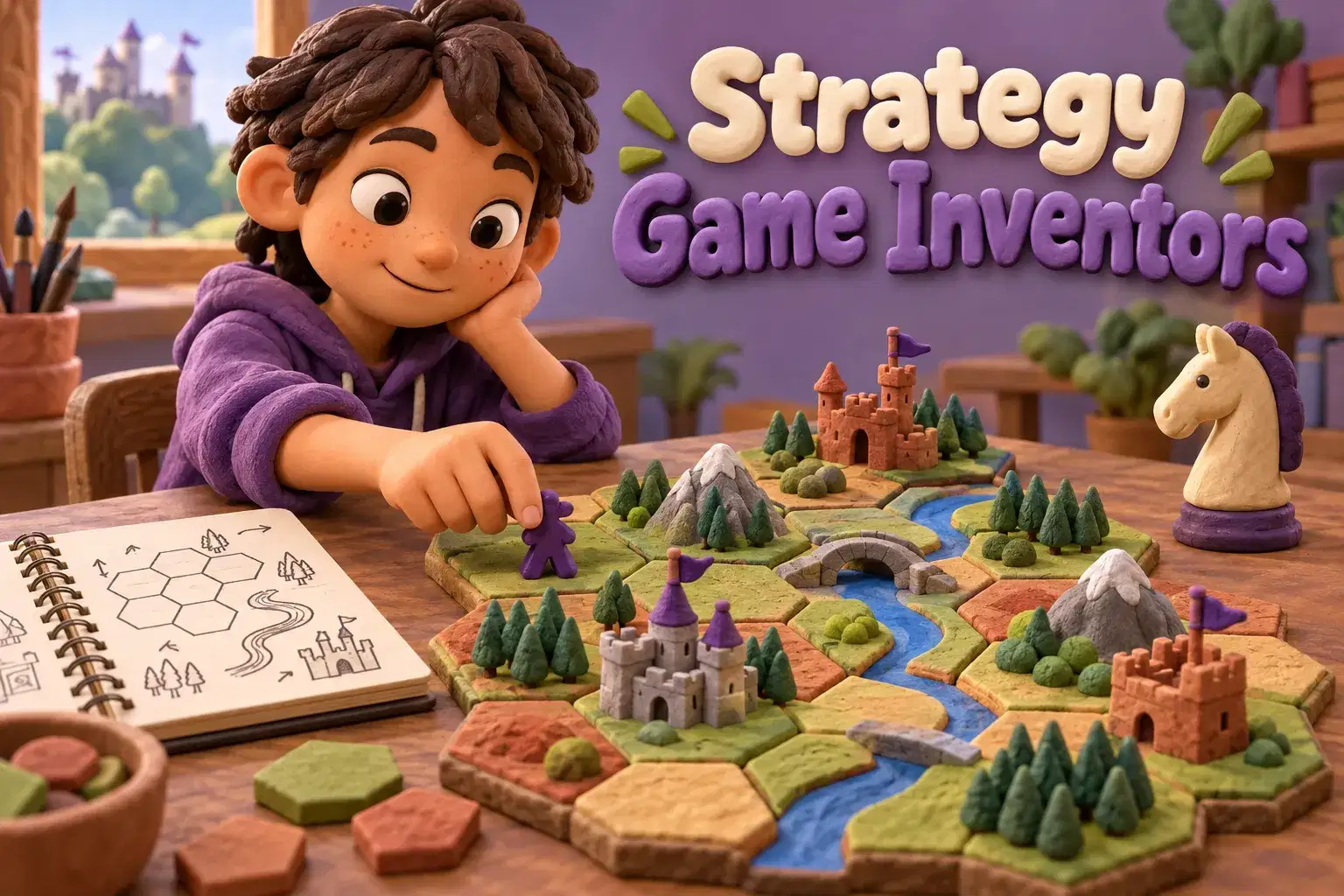
Kids invent an original strategy board game from scratch, designing the board, pieces, rules and winning conditions, then playtest, balance and present a finished prototype over six weeks.
Paid once.
This course teaches children how strategy games really work. Learners look at what makes classic abstract games interesting, such as meaningful choices, fair starting positions and more than one path to victory, and use those ideas in a game of their own.
Week by week they sketch a board, make pieces from paper and household items, write clear rules and test their game against family and classmates. They learn to spot a dominant strategy and fix it, tune the game's length, and write a rulebook someone else could follow. The course ends with a presentation of their finished prototype.
This is a six-week course with one 45-minute class per week. Each class builds on the previous one, taking the game from idea to prototype, and ends with a short playtest task to try at home before the next class.
Week 1: What Makes a Strategy Game Tick – Learners play quick abstract games, discuss interesting choices and fairness, and brainstorm a theme and goal for their own game.
Week 2: Boards, Pieces and Movement Rules – Kids sketch a board layout, make paper pieces and decide how each piece moves or captures.
Week 3: Win Conditions and Turn Structure – Learners choose how the game is won, set what a player can do on a turn, and write a first draft of rules.
Week 4: First Playtest and Rule Fixes – Kids play their prototype with a classmate, note confusing moments, and rewrite rules that caused arguments or stalls.
Week 5: Balancing Strategy and Game Length – Learners find any unbeatable strategy, adjust pieces or board to balance it, and tune how long a game lasts.
Week 6: Rulebook Finish and Game Showcase – Kids complete a clear rulebook and present their finished game, explaining its strategy and how they improved it.

Design an original board, pieces and movement rules
Write a clear rulebook another player can follow
Run a playtest and record what needs fixing
Identify and balance an overpowered strategy
Present a game and explain design choices
Learners should have played a few strategy board games like checkers or chess and be able to explain the rules of one. A computer or tablet with camera, card stock and markers are needed.
Card stock and markers make the board, scissors and a ruler help shape pieces, and coins or buttons work as quick playtest tokens.
A step-by-step plan of what your child learns, class by class. · 6 Weeks
Learners play quick abstract games, discuss interesting choices and fairness, and brainstorm a theme and goal for their own game.
Kids sketch a board layout, make paper pieces and decide how each piece moves or captures.
Learners choose how the game is won, set what a player can do on a turn, and write a first draft of rules.
Kids play their prototype with a classmate, note confusing moments, and rewrite rules that caused arguments or stalls.
Learners find any unbeatable strategy, adjust pieces or board to balance it, and tune how long a game lasts.
Kids complete a clear rulebook and present their finished game, explaining its strategy and how they improved it.
Next 7 days, US Eastern Time
Your child should have played a few strategy games, like checkers, chess or similar abstract games, and be able to explain how one is played. No design experience is needed.
A playable prototype of their own strategy board game, with a homemade board, pieces, a written rulebook and a short presentation explaining how the game works and how they balanced it.
Card stock or a cereal box for the board, paper, markers, scissors, a ruler and small tokens like coins or buttons. Everything can come from around the house.
Six weeks, with one 45-minute class each week. Each class moves the game a step forward, from first idea through playtesting to a final showcase.
Yes, light homework of about 15 to 20 minutes a week, usually playing the prototype with a family member and noting what to fix. No certificate is given for this course.
It helps. Playing the game once or twice a week with a sibling or parent gives your child real feedback. If that is hard to arrange, learners can play both sides to test their rules.
Ages are flexible, so a younger child who already enjoys strategy games and can write simple rules may do well. Expect them to need a little extra help with the written rulebook.
Yes, if you cancel before the second class starts you get a full refund. After that, classes already started count as used and unstarted ones are refunded to store credit or your original payment method, via the parent dashboard.
Harshita designs and leads weekly Roblox Five Nights at Freddy's sessions in a private, moderated server that focus on strategy, character-based play, and cooperative problem solving. She designates player positions, introduces themed challenges, and scaffolds tasks so learners g…
Sonia K.
Ages 7–12 · 50 min · 1 / Week
$20.00per classSee schedule
Nandini K.
Ages 8–12 · 45 min · 4 / Week
$18.00per classSee schedule
Bhavya M.
Ages 9–12 · 45 min · 1 / Week
$19.00per classSee schedule
Avni K.
Ages 12–16 · 50 min · 4 / Week
$20.00per classSee schedule
Harshita R.
Club · Ages 13–17 · 50 min · 1 / Week
$18.00per classSee schedule
Aditi K.
Club · Ages 10–13 · 45 min · 1 / Week
$15.50per classSee schedule
Ishita P.
Club · Ages 8–13 · 55 min · 1 / Week
$16.50per classSee schedule
Sonia K.
Beginner
Level
7–12
Ages
50 min
Duration
1 / Week
Classes
6
Weeks
Anne M.
Beginner
Level
7–10
Ages
30 min
Duration
1 / Week
Classes
Ongoing
Weeks
Nandini K.
Beginner
Level
8–12
Ages
45 min
Duration
4 / Week
Classes
1
Weeks
Bhavya M.
Beginner
Level
9–12
Ages
45 min
Duration
1 / Week
Classes
1
Weeks
Avni K.
Beginner
Level
12–16
Ages
50 min
Duration
4 / Week
Classes
1
Weeks
Harshita R.
Beginner
Level
13–17
Ages
50 min
Duration
1 / Week
Classes
Ongoing
Weeks
Aditi K.
Beginner
Level
10–13
Ages
45 min
Duration
1 / Week
Classes
Ongoing
Weeks
Ishita P.
All Levels
Level
8–13
Ages
55 min
Duration
1 / Week
Classes
Ongoing
Weeks