





Match and Snap: Speedy Pair Games
Learners design a deck of matching pairs with their own pictures and invent a fast rule for spotting and claiming a match.
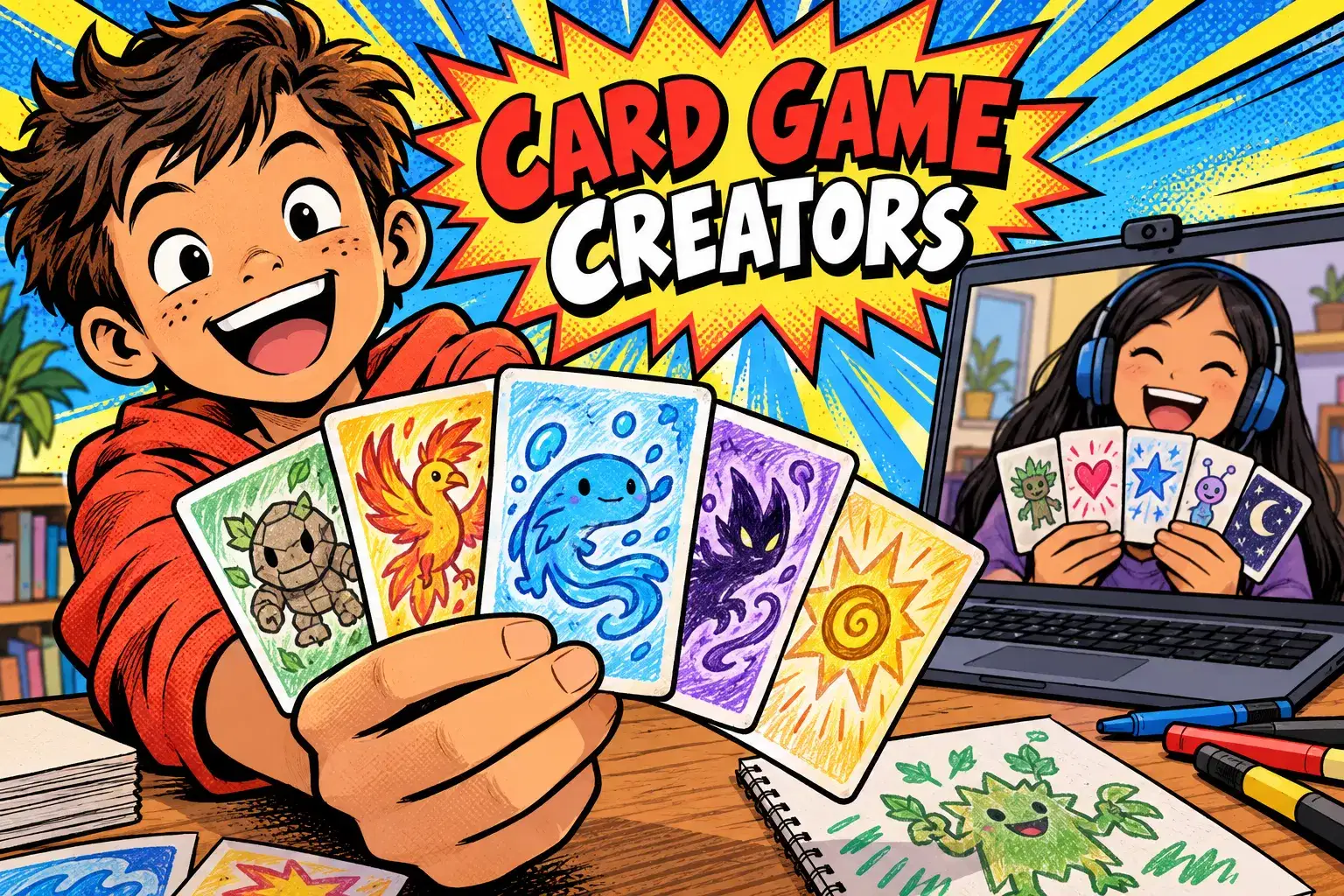
In this drop-in club, kids invent a new card game each week using index cards and markers, testing a fresh mechanic like matching, trading or bluffing and writing rules on a quick design sheet.
Paid once.
Every week brings a new card game challenge. Learners take a simple game idea, such as matching pairs, collecting sets or racing to empty a hand, and twist it into something original with their own theme, card art and special rules.
Kids sketch a deck of 10 to 20 index cards, write their rules on a quick one-page design sheet, then play a short round and think critically about what worked. Is it too easy? Does one card always win? They tweak a rule and try again, building a growing collection of their own card games over time.
This is a drop-in weekly club with 30-minute meetings. Each week has its own card game theme that starts and finishes in one session, so new learners can join any week and returning members keep adding new games to their collection.
Session theme 1: Match and Snap: Speedy Pair Games – Learners design a deck of matching pairs with their own pictures and invent a fast rule for spotting and claiming a match.
Session theme 2: Set Collectors: Gather, Trade and Win – Kids create card families to collect, add a trading rule and test whether everyone has a fair chance to finish a set.
Session theme 3: Power Cards: Special Moves and Surprises – Learners add a few power cards like skip, swap or draw two, then test whether these make the game more exciting or unbalanced.
Session theme 4: Bluff and Guess: Hidden Card Challenges – Kids design a game where players hide or guess cards, write clear rules and playtest how to keep it fair and fun.

Design a small deck of cards around a theme
Write clear rules on a one-page design sheet
Spot balance problems like one card always winning
Improve a game by changing one rule and retesting
Explain how their game is played to others
No experience needed. Learners should be able to read and write short sentences. They need a device plus index cards or paper cut into cards, and markers or colored pencils.
Index cards become each week's deck, markers and pencils are for card art, and paper holds the quick rule sheet.
A step-by-step plan of what your child learns, class by class.
Learners design a deck of matching pairs with their own pictures and invent a fast rule for spotting and claiming a match.
Kids create card families to collect, add a trading rule and test whether everyone has a fair chance to finish a set.
Learners add a few power cards like skip, swap or draw two, then test whether these make the game more exciting or unbalanced.
Kids design a game where players hide or guess cards, write clear rules and playtest how to keep it fair and fun.
Next 7 days, US Eastern Time
Yes. This is a drop-in club, and each 30-minute meeting is a complete card game challenge with its own theme. A new learner can join any week, and nothing from earlier weeks is needed to take part.
No experience is needed. We start each week from a simple, familiar idea such as matching pairs, then show how to change it into a brand-new game. Being able to read and write short sentences is the only skill we assume.
Each week your child designs a small deck of 10 to 20 cards, writes the rules on a one-page design sheet, and playtests the game. Over several weeks they build a collection of original card games they can play with family.
After each test round, learners ask questions like: Is it too easy? Does one card always win? Is anyone stuck waiting too long? They change one rule at a time and retest, which builds the habit of noticing problems and testing fixes.
Very likely. The range of 7 to 10 is a guide, not a hard limit. Older learners who enjoy creative challenges often add more complex rules and power cards, and the open-ended weekly themes give them room to stretch.
There is no homework. Each game is designed and tested within the session, though many kids enjoy playing their decks at home. There is no certificate for the club.
If you are on a weekly plan, cancelling stops future billing. You get a full refund if you cancel before the second class starts. After that, classes already started count as used and classes not yet started are refunded, to store credit or your original payment method. Cancel from the class in your parent dashboard.
An experienced team of technology graduates introduces learners to app development, Java, Python, and block-based coding using age-appropriate projects. Lessons emphasize hands-on building of apps, games, and interactive stories with Thunkable, Scratch Jr, and Python tools. Instr…
Sonia K.
Ages 7–12 · 50 min · 1 / Week
$20.00per classSee schedule
Nandini K.
Ages 8–12 · 45 min · 4 / Week
$18.00per classSee schedule
Bhavya M.
Ages 9–12 · 45 min · 1 / Week
$19.00per classSee schedule
Avni K.
Ages 12–16 · 50 min · 4 / Week
$20.00per classSee schedule
Harshita R.
Club · Ages 13–17 · 50 min · 1 / Week
$18.00per classSee schedule
Aditi K.
Club · Ages 10–13 · 45 min · 1 / Week
$15.50per classSee schedule

Ishita P.
Club · Ages 8–13 · 55 min · 1 / Week
$16.50per classSee schedule
Sonia K.
Beginner
Level
7–12
Ages
50 min
Duration
1 / Week
Classes
6
Weeks
Harshita R.
Intermediate
Level
9–13
Ages
45 min
Duration
1 / Week
Classes
6
Weeks
Nandini K.
Beginner
Level
8–12
Ages
45 min
Duration
4 / Week
Classes
1
Weeks
Bhavya M.
Beginner
Level
9–12
Ages
45 min
Duration
1 / Week
Classes
1
Weeks
Avni K.
Beginner
Level
12–16
Ages
50 min
Duration
4 / Week
Classes
1
Weeks
Harshita R.
Beginner
Level
13–17
Ages
50 min
Duration
1 / Week
Classes
Ongoing
Weeks
Aditi K.
Beginner
Level
10–13
Ages
45 min
Duration
1 / Week
Classes
Ongoing
Weeks
Ishita P.
All Levels
Level
8–13
Ages
55 min
Duration
1 / Week
Classes
Ongoing
Weeks