By Addison Bradley ·
Stargazing with Kids: A Beginner's Guide
Start stargazing with your child using a free star map app, your eyes and binoculars. Easy targets, a first-night plan and safety tips for families.
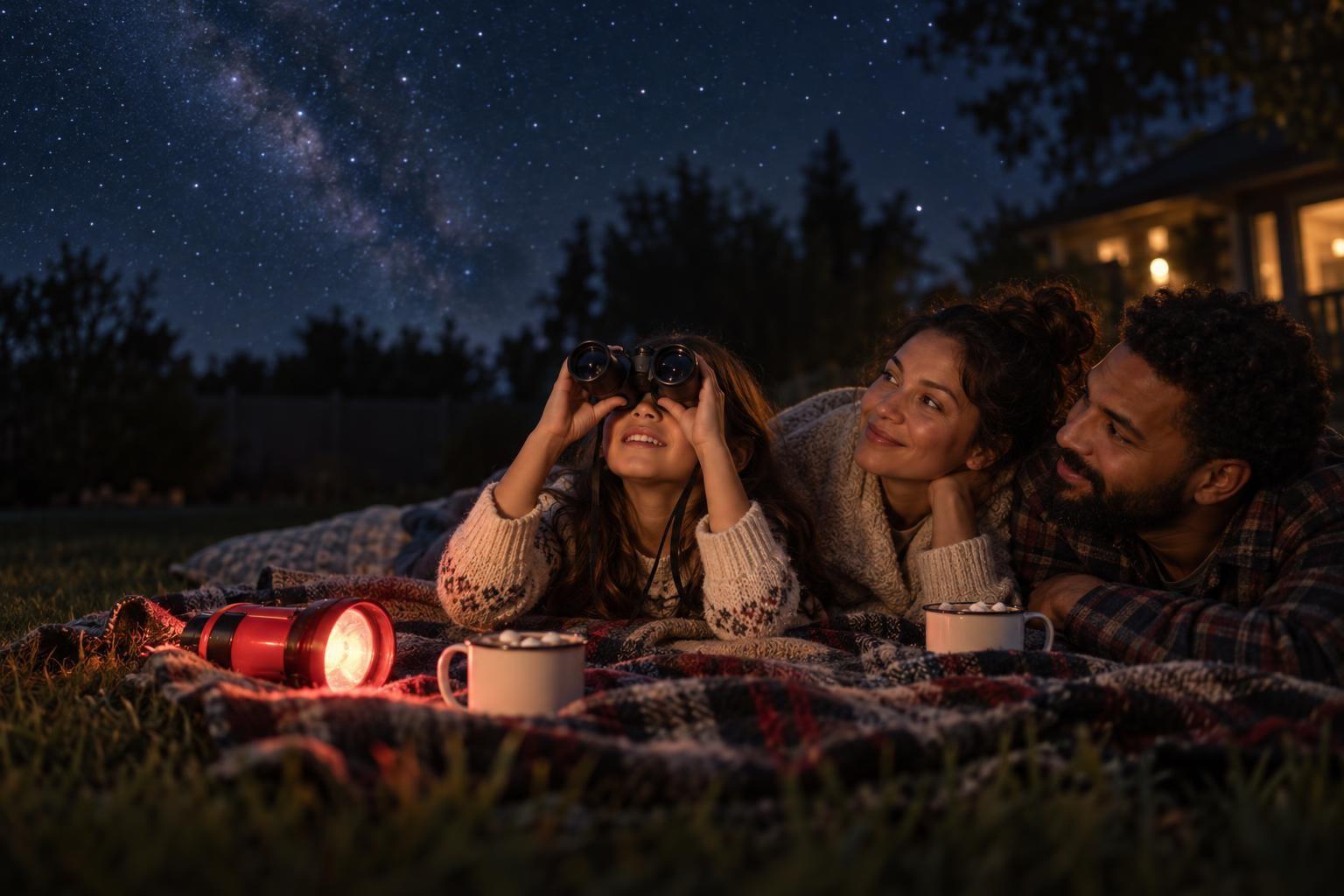
Start stargazing with a free star map app and your own eyes, then add binoculars. Look for the Moon, bright planets and easy constellations before you think about buying a telescope. You can begin tonight from your backyard.
The best beginner kit is mostly free: your eyes, a star map app or planisphere, and later a pair of binoculars. Pick a clear night, let eyes adjust to the dark, use red light, and aim for two or three easy targets such as the Moon, a bright planet and the Big Dipper. Keep sessions short, never look at the Sun, and wait on a telescope until interest lasts for months.
What you need to get started
The best beginner kit is mostly free. Here's how the main tools compare.
| Tool | Cost | What it shows | Best time to add it |
|---|---|---|---|
| Your eyes | Free | Moon, bright planets, constellations, meteors, the space station | Night one |
| Star map app or planisphere | Free to low cost | Names of stars and planets you're looking at | Night one |
| Binoculars | Varies | Moon craters, star clusters, Jupiter's brightest moons as tiny dots | Once your child knows a few targets |
| Telescope | Higher | Saturn's rings, more lunar detail, fainter objects | When interest lasts for months |
Many families already own binoculars. Steady them by leaning on a fence or car roof, or sit in a reclining chair.
Your first night out: step by step
- Check the weather. Pick a clear night. Even thin clouds hide most stars.
- Check the Moon. A bright full Moon washes out faint stars. Nights near a crescent or first-quarter Moon are great for beginners.
- Find a dark-ish spot. A backyard or park away from streetlights works. Turn off porch lights if you can.
- Dress warmly. Nights get cold, even in summer. Bring blankets and chairs that let you lean back.
- Let your eyes adjust. NASA notes that eyes take about 30 minutes to fully adapt to the dark. Avoid bright screens during that time.
- Use red light. A red flashlight or your phone's red or night mode protects night vision.
- Open your star map app. Hold it up to the sky to name what you see, then put it away and look with your eyes.
- Pick two or three targets. Don't try to see everything. A short, successful night beats a long, frustrating one.
Easy targets for kids
The Moon
The Moon is the perfect first target. With binoculars, kids can see craters and dark "seas," especially along the line between light and shadow. Have them sketch it over a few weeks and watch the phases change.
Bright planets
Planets look like bright stars that don't twinkle much. Venus, Jupiter and Saturn are often easy to spot. A star map app shows which ones are up tonight. NASA's monthly "What's Up" skywatching guide is another great source.
Easy constellations
Part of Ursa Major, visible much of the year from the US. Its shape is easy for kids to spot.
Follow the two stars at the end of the Big Dipper's "cup" to find Polaris.
A winter favorite. Look for three stars in a row that form his belt.
A bright "W" or "M" shape across from the Big Dipper.
The International Space Station
Kids love seeing a spacecraft with people aboard. It looks like a bright, steady dot moving quickly across the sky. NASA's free Spot the Station app sends alerts for upcoming passes in your area. Our guide on how to see the space station from your backyard walks through it step by step.
Meteor showers
Showers like the Perseids in August and the Geminids in December can be fun family events. No equipment is needed. Lie back, look up and be patient.
Keeping kids interested
- Keep it short. Twenty to thirty minutes is plenty for young kids.
- Bring snacks and cocoa. Make it feel like an adventure.
- Start a sky journal. Kids can draw what they saw and note the date.
- Tell the stories. Many constellations have myths from cultures around the world.
- Join others. Local astronomy clubs, planetariums and parks often hold free public star parties.
A live space class can answer your child's big questions, like why stars twinkle or how planets move. It's a fun way to turn backyard sightings into real understanding.
When to buy a telescope
Wait until your child has enjoyed naked-eye and binocular viewing for a while. A telescope takes patience to set up and aim. Kids who already know where to look get far more from it.
If you do buy one, a planetarium or astronomy club can help you choose. Many clubs let families try telescopes at public events first.
Safety and what to watch for
- Never look at the Sun with eyes, binoculars or a telescope. It can cause permanent eye damage. Only use certified solar viewers or filters for eclipses.
- Stay safe outside at night: Choose familiar, safe places, and keep young kids close.
- Screen time: Use apps to find objects, then put phones away. The goal is looking up, not down.
- Weather and cold: Watch for chilly kids and plan an easy way back inside.
Frequently asked questions
What age is good for stargazing?
Kids of any age can enjoy the Moon and bright stars. Around ages 5 to 7, many can find constellations with help. Older kids can use binoculars and apps on their own.
Can we stargaze in a city?
Yes. City lights hide faint stars, but the Moon, bright planets and the space station are still easy to see. Darker spots outside town reveal much more.
Do we need a telescope to see planets?
No. Several planets are visible with just your eyes. Binoculars can show Jupiter's brightest moons as small dots. A telescope adds detail like Saturn's rings.
Explore the universe with your young astronomer
Live online space classes turn backyard sightings into real understanding, with teachers who love planets, stars and space travel.