By Amelia ·
What to Do When Your Child Says They Hate Math
When your child says they hate math, get curious—not panicked. Learn how to find the sticking point and reduce math homework battles.
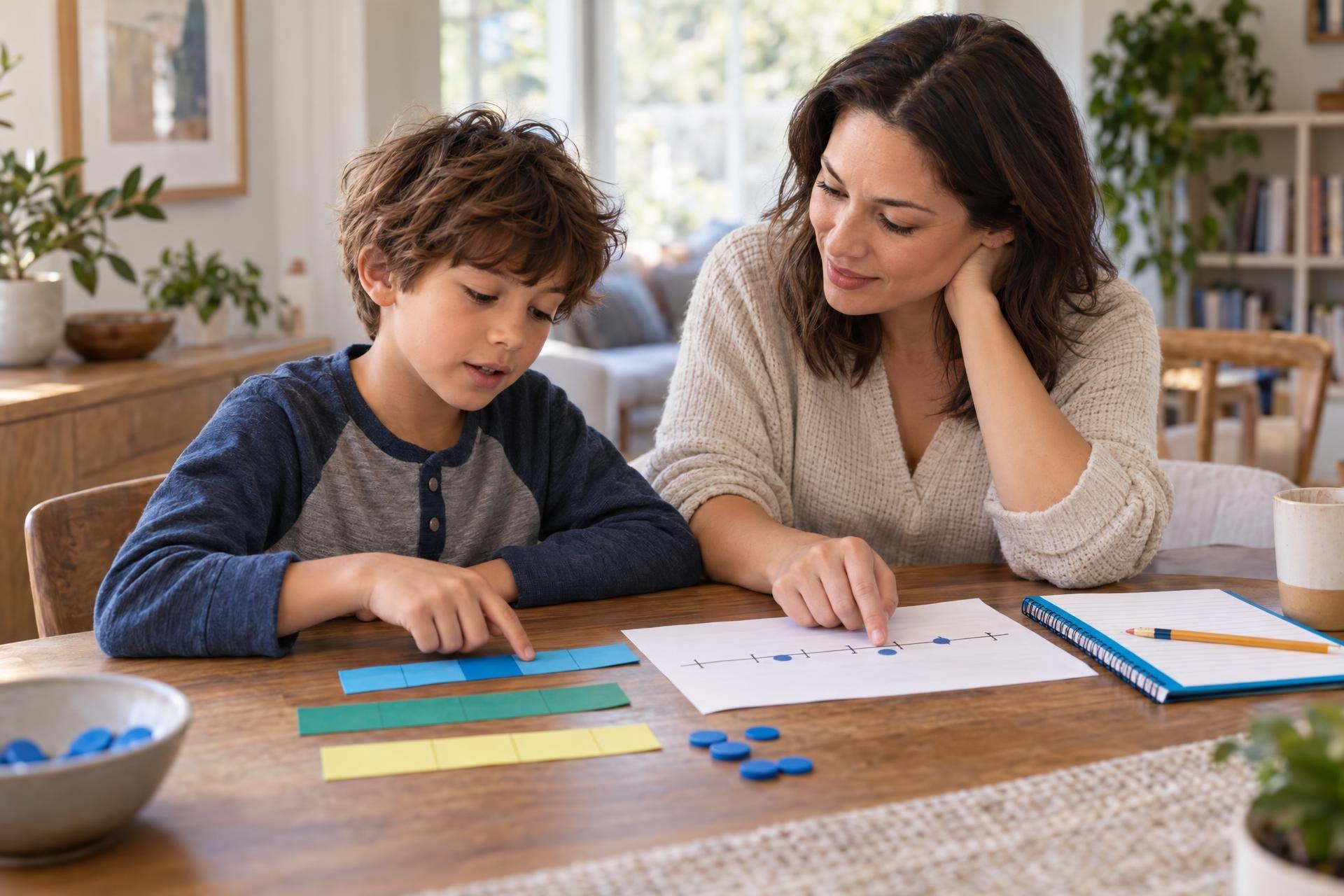
“I hate math” can land hard. Maybe it comes after tears over homework, a refusal to start an assignment, or a quiet comment that makes you worry your child is falling behind.
But that sentence is rarely a final verdict on your child’s ability. More often, it is a quick way of communicating something harder to name: I don’t understand this. I don’t know where to begin. I’m worried I’ll get it wrong. Everyone else seems faster than me.
The most helpful first response is usually not more worksheets or a speech about why math matters. It is curiosity. When you can turn a broad statement into a specific clue, you and your child have something you can work with.
When a child says they hate math, start by looking for the specific obstacle rather than treating the statement as a judgment about ability. The challenge may be a missing building block, unclear directions, speed pressure, word problems, fear of mistakes, or simple end-of-day fatigue. Ask where the work stopped making sense, choose one manageable problem, and make the idea visible with a drawing, objects, or a number line. If patterns persist, share what you notice with the teacher and consider support that offers patient explanation and guided practice.
What “I hate math” may really mean
Children between 7 and 13 are still building both math skills and the language to describe what feels difficult. A child may dislike a subject because one current task is hard—not because they cannot learn it.
Listen for the pattern underneath the statement. Math may feel especially frustrating when a child is dealing with:
- A missing building block. Division can feel impossible when multiplication facts are not yet secure. Fractions can feel mysterious if equal parts are not concrete.
- Confusion about the lesson or directions. Your child may understand the numbers but not know which operation, strategy, or first step the problem calls for.
- Speed pressure. Timed work or watching peers finish first can make a child focus on being fast rather than making sense of the math.
- Word-problem overload. Reading, sorting relevant information, and choosing an operation are separate demands before calculation even begins.
- Fear of mistakes. A child who has had several difficult experiences may avoid starting because being wrong feels embarrassing or discouraging.
- A mismatch in explanation. Sometimes the classroom method has not clicked yet. A drawing, object model, number line, or different explanation may make the same idea clearer.
- Timing and fatigue. A child who can think well at school may have little patience left after a long day.
None of these possibilities automatically points to a particular diagnosis or defines your child’s potential. They are simply useful places to investigate.
Start with questions, not correction
When frustration is high, a child may not be ready to explain everything. Keep the conversation short and specific. The goal is not to interrogate them or solve an entire page at once; it is to find the point where things stopped making sense.
Try a curiosity-first question: “Can you show me the first part that feels confusing?”
You might also try:
- “Is the hard part getting started, remembering a fact, or knowing what to do with the numbers?”
- “Do the directions make sense, or is it hard to tell what the question is asking?”
- “What did your teacher show you to do first?”
- “Would it help to draw this, use something we can move around, or talk through one step?”
These questions shift the focus away from character and toward the task in front of your child.
| Instead of saying… | Try saying… |
|---|---|
| “You just need to try harder.” | “Which part is confusing: the directions, the numbers, or knowing what operation to use?” |
| “Math is easy.” | “It may not feel easy yet. Let’s find one part you can do and build from there.” |
| “You’re good at math!” | “I noticed you drew the problem first. That helped you see what was happening.” |
| “Just guess.” | “Tell me what you know so far, and we’ll choose a next step.” |
Specific feedback matters because it gives children something they can use again: a strategy, a representation, or a way to begin.
Replace labels with clues
Labels can make a temporary struggle feel permanent. “I’m not a math person” is hard to act on. “I get lost after the first sentence of a word problem” is a clue.
Gently model more precise language at home. You do not need to correct your child’s feelings or insist that they love math. You can simply separate the child from the challenge:
“This fraction problem feels confusing right now. Let’s figure out what part is unclear.”
Over time, help your child distinguish among different kinds of difficulty:
“I do not know what the question is asking.”
“I know the strategy, but I forget the multiplication facts.”
“I can do one-step problems but get mixed up when there are several steps.”
“I understand when someone shows me, but I do not know how to start alone.”
This is not just a language exercise. It helps you choose a response that fits the problem instead of treating every struggle as a need for more practice.
Try a calmer 10-minute math reset
Long, tense homework sessions rarely create the conditions for clear thinking. A brief routine can lower the stakes while still keeping your child connected to the work.
- Pause first. If emotions are rising, take a short reset: water, movement, a snack, or five quiet minutes. Agree that you will come back to just one problem.
- Choose one manageable problem. Do not begin with the whole worksheet. Pick a problem that is representative of the difficulty but not the most overwhelming item on the page.
- Locate the stuck point. Ask your child to point to the exact line, word, number, or step where the problem stopped making sense.
- Make the math visible. Draw it, build it, mark it on a number line, or say the steps aloud. Use the representation that fits the idea.
- Try one next step. Offer a prompt rather than taking over: “What could we do first?” or “What does this drawing tell us?”
- Close with one concrete takeaway. Your child might say, “I need to circle what the question asks,” or “Four groups of six means I can draw four rows of six.”
End before the interaction becomes a battle when possible. The goal of this routine is not to finish every question. It is to help your child experience a small, real moment of understanding.
Use models before asking for more answers
When a child is stuck, it can be tempting to repeat the explanation louder, faster, or with more problems. Often, a better first move is to represent the idea differently.
Concrete and visual models, clear math language, and guided problem solving are widely used instructional supports. They do not solve every difficulty, but they can help reveal what a child understands and where the connection breaks down.
Compare equal-sized wholes
Use paper strips, a snack divided into equal parts, or a number line. Before asking whether one-half is greater than one-fourth, let your child compare equal-sized wholes cut into halves and fourths. Then connect what they see to the symbols.
Build equal groups
Model 4 × 6 as four groups of six counters, coins, blocks, or quick circles on paper. Then connect the model to the equation. This makes multiplication more than a fact to memorize: it represents equal groups.
Draw the situation first
Ask your child to circle the question being asked, draw the situation, and explain why they chose an operation. A child may calculate accurately but still need support deciding whether the situation calls for addition, subtraction, multiplication, or division.
Let your child do as much of the thinking and explaining as they can. Your role is to make the path easier to see, not to become the person who completes the assignment.
Look for patterns before choosing a bigger solution
A few days of simple observation can be more useful than a general sense that math is “always” hard. Notice:
- Which topics trigger the most resistance
- Whether difficulty is greater with homework, quizzes, timed work, or classwork
- Whether the challenge is reading, recalling facts, choosing a strategy, or carrying out steps
- What time of day frustration appears
- What helps your child re-engage, even briefly
A useful teacher conversation: “My child gets stuck most often on multi-step word problems. Could you share the strategy or model you are using in class so we can reinforce it consistently?”
Teachers can help clarify which skills are being taught, what supports are already available, and whether there is a particular prerequisite skill to revisit. If difficulty is persistent, schoolwork is consistently inaccessible, or concerns are affecting your child’s participation or progress, partnering with the teacher is an important next step.
When extra support may help
Extra support does not need to mean a high-pressure tutoring schedule. A well-matched learning experience can give a child another explanation, guided practice, and room to ask questions without feeling rushed.
Look for support that offers:
- Age-appropriate pacing and a clear focus on the current skill
- Interactive problem solving rather than answer-giving
- Explanations that use examples, drawings, and mathematical language
- Opportunities to practice in manageable amounts
- Feedback that names strategies and progress specifically
- A patient environment where questions are welcome
No class, game, tutor, or mindset change can promise that a child will suddenly love math—or that progress will be immediate. The right support can, however, make the next step feel possible. That matters.
What parents can do next
- Respond to “I hate math” with one specific question: ask where the work became confusing.
- Try the 10-minute reset with one manageable problem, rather than starting with the whole worksheet.
- Use a drawing, objects, or a number line before adding more practice problems.
- Notice patterns for a few days and share concrete observations with your child’s teacher when needed.
- Consider targeted, patient support if the difficulty remains persistent or schoolwork is consistently inaccessible.
The goal is capability, not constant enthusiasm
Children do not have to enjoy every math assignment. The more realistic goal is to help them see that confusion can be named, explored, and worked through.
When your child says, “I hate math,” try to hear it as an invitation to slow down: find the specific obstacle, reduce the pressure, and build one small success at a time. That response will not make every homework night easy. But it can replace a broad, discouraging label with a workable next step.
For more on evidence-informed math supports, see the U.S. Department of Education What Works Clearinghouse practice guides on assisting elementary students struggling with mathematics and assisting elementary and middle school students struggling with mathematics.
A fresh way into a math concept
For families looking for an additional option, Undoschool offers live math learning experiences designed to give children guided practice and a fresh way into a concept at their current level.