By Taylor Holt ·
How Kids Can Build Their Own Fantasy World
Help your child build a fantasy world step by step: draw a map, name places, invent creatures, set rules of magic, and keep it all in a world notebook.
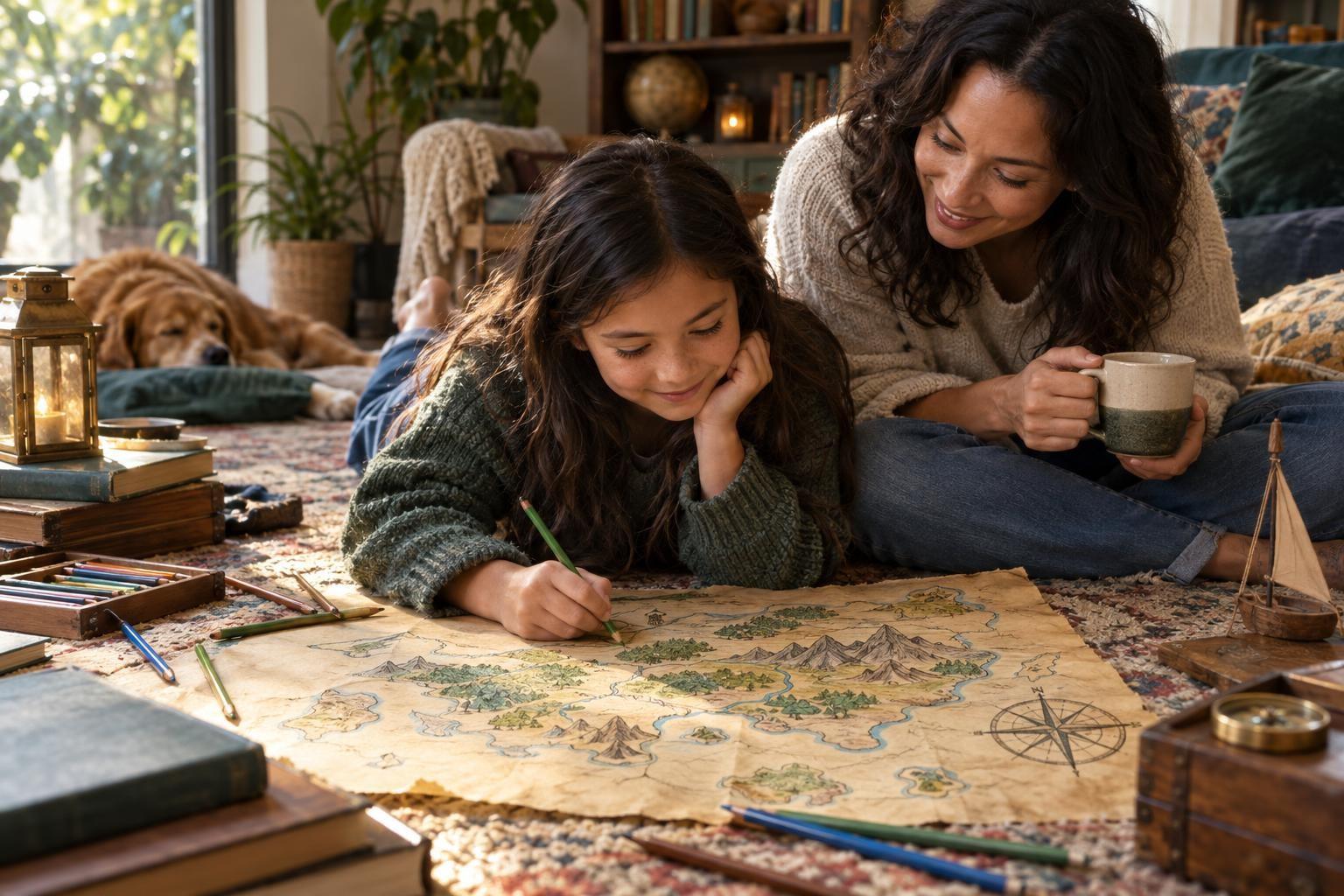
The easiest way for a child to build a fantasy world is to draw a map first, then name the places, invent creatures and decide how magic works. A dedicated world notebook keeps every idea in one place, so the world can grow over weeks or even years.
Worldbuilding mixes art, writing, geography and logic. Set up a world notebook, draw a rough map, name places, design creatures that fit their homes, give magic clear rules and limits, then use the world for stories. Ask curious questions rather than supplying ideas, and keep it playful, not homework.
Why worldbuilding is great for kids
Designing a world mixes art, writing, geography and logic. Kids practice making choices and sticking to their own rules. It also gives them a ready-made setting for stories, games and drawings.
Step 1: Start a world notebook
Any notebook works, but a dedicated one makes the project feel special. Help your child set up a few sections with tabs or sticky notes.
- Map
- Places
- Creatures
- People and characters
- Magic and rules
- History and legends
- Story ideas
Some kids prefer a binder, so they can add and move pages. Older kids might use a simple digital document instead.
Step 2: Draw the map
A map turns a vague idea into a real place. It does not need to be neat.
- Draw the coastline of an island or continent. Wobbly shapes look more natural than circles.
- Add mountains, forests, rivers, lakes and deserts. Rivers usually flow from mountains down to the sea.
- Place a few towns, castles or hidden spots. Think about why people would live there, such as near water.
- Add something mysterious, like an unmapped region or a floating island.
- Include a compass rose and a key that explains the symbols.
Crumpling the paper, then flattening it, makes the map look old. Light tea staining also works, with an adult's help.
Step 3: Name places and peoples
Names give a world its flavor. Kids can mix word parts, flip words backward, or combine two words.
- Describe the place: "Frostfang Peaks" or "Whispering Marsh."
- Build from sounds: pick a few sounds that feel right and reuse them across names.
- Keep a name list in the notebook so spellings stay consistent.
Step 4: Invent creatures
Creatures are often a child's favorite part. Encourage them to think about how each creature fits its home.
| Question | Example answer |
|---|---|
| Where does it live? | In ice caves in the northern mountains |
| What does it eat? | Glowing moss that grows on the cave walls |
| How does it protect itself? | It turns see-through when scared |
| How do people feel about it? | Miners think it brings good luck |
Drawing each creature with a short fact card turns the notebook into a field guide.
Step 5: Decide how magic works
Good magic has rules and limits. Without them, any problem can be solved instantly and stories lose their tension.
- Who can use magic? Everyone, a few people, or only certain creatures?
- Where does it come from? Words, objects, nature, or the stars?
- What does it cost? Maybe it makes users tired, or only works at night.
- What can it never do? A clear limit sparks great story problems.
Step 6: Add history and culture
Older kids can go deeper. They might invent a legend about how the world began, a holiday, a food, or a rivalry between two towns. Short timelines help track what happened when.
Step 7: Tell stories in the world
Once the world exists, it is ready for adventures. Kids can write a short story, draw a comic, or act out a scene with siblings.
If they get stuck, a prompt can help. Our list of 50 creative writing prompts for kids works well when you swap in places and creatures from their own world.
Tips for parents
- Ask curious questions instead of suggesting ideas. "What happens if someone crosses that river?" invites more thinking.
- Let the world change. Kids often redraw maps and rewrite rules, and that is part of the process.
- Encourage original ideas. It is fine to be inspired by favorite books, but help your child make the world their own.
- Keep it low pressure. Worldbuilding is play, not homework.
What to watch for
If your child shares their world online, such as on fan forums or creative sites, check the site's age rules first. Help them avoid sharing their real name, school or photos. Many kids are happiest sharing with family, friends or a small class instead.
A live class can also give young worldbuilders an audience and feedback from a teacher who loves fantasy as much as they do.
Frequently asked questions
What age is right for worldbuilding?
Kids as young as six can draw a map and invent creatures. Older kids can add rules of magic, history and longer stories.
My child keeps starting new worlds. Is that okay?
Yes. Trying many ideas is normal and builds creativity. Some kids later combine pieces of several worlds into one favorite.
Does my child need to be good at drawing?
No. Simple shapes and labels work fine. The ideas matter more than the art.
Is it okay if their world borrows from favorite books?
Yes, inspiration is a natural starting point. Encourage your child to change names, rules and creatures until the world feels like their own.
Give your young worldbuilder more magical adventures
Fantasy-themed live classes give kids a friendly audience, fresh ideas and a teacher who loves magical worlds as much as they do.