By Courtney Mitchell ·
DIY Mystery Escape Room for Kids at Home
Build a DIY mystery escape game at home in under an hour: a clue trail, riddles, simple codes, invisible ink and a locked prize, with tips for every age.
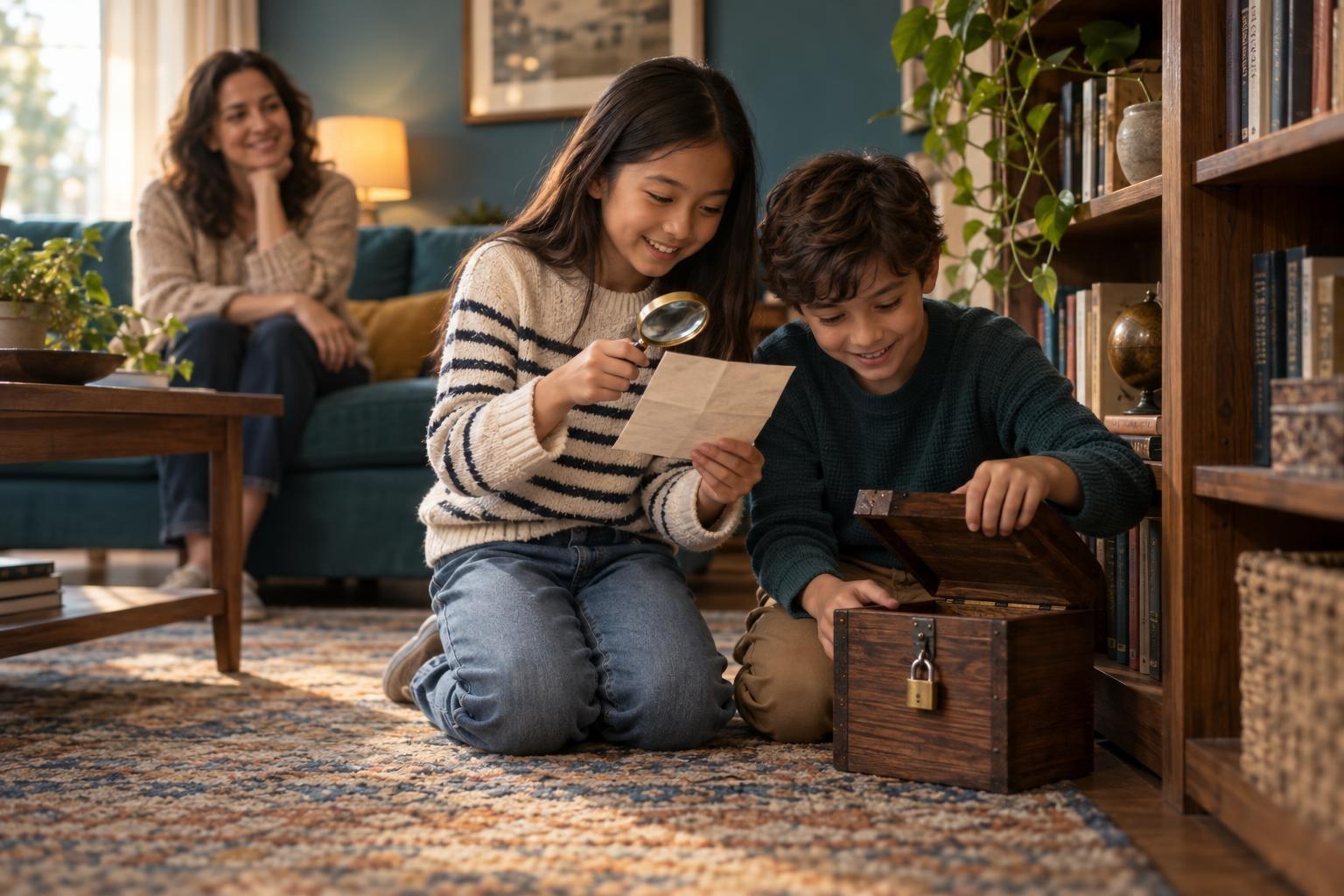
To make a mystery escape game at home, hide three to five clues around the house so each one leads to the next, and finish with a locked box or a hidden prize. Use simple riddles and codes your child can crack, and you'll have an afternoon of detective fun with supplies you already own.
Pick a simple story, choose the final hiding spot, then work backward to build a trail of three to seven clues matched to your child's age. Mix riddles, codes and hands-on puzzles, test every clue, keep hint cards ready, and remember: only the prize gets locked, never a person.
What you'll need
- Paper, pens and envelopes for clues
- A small box, tin or zip bag for the final prize
- A cheap combination lock or a lockable box (optional, but kids love it)
- A prize, such as a treat, a small toy, a movie night ticket or a "case closed" certificate
- Tape and a timer
- Optional extras: a flashlight, a magnifying glass, a mirror, white crayon and watercolor paint
Step-by-step: build your escape game
- Pick a story. A simple mystery gives the clues a purpose. For example: "The cookie jar has been stolen! Follow the clues to find it before the timer runs out."
- Choose the final hiding spot. Decide where the locked box or prize will be. Then work backward from there.
- Map your clue trail. List three to five hiding spots, like the fridge, a bookshelf, under a pillow and inside a shoe. Each clue should point to the next spot.
- Write the clues. Use a mix of riddles, codes and hands-on puzzles. Number them on the back so you can track the order.
- Hide everything in reverse. Start with the final prize, then hide the clue that points to it, and so on. Keep the first clue in your hand.
- Set the timer and start. Thirty to forty-five minutes is a good length for most kids. Hand over the first clue and let the detective work begin.
- Offer hints if needed. Give each player two or three "hint cards" to trade in when they get stuck.
Clue and puzzle ideas
Riddles
Riddles that describe a hiding spot are easy to write. For example: "I'm cold inside and full of food. Open me to find your next clue." (The fridge.)
Write your own about common household objects like a mailbox, a washing machine or a bathtub.
Simple codes
- Number code: A=1, B=2, C=3 and so on. "2-5-4" spells "BED."
- Backward words: Write the hiding spot backward, like "ROOD" for "door."
- Shift code: Move each letter one place forward in the alphabet. "CBUI" becomes "BATH."
- Mirror writing: Write a clue backward so it can only be read in a mirror.
Give younger players a code key. Let older kids figure it out on their own.
Hands-on puzzles
- Invisible ink: Write a clue in white crayon on white paper. Kids brush watercolor over it to reveal the words.
- Jigsaw clue: Write a clue on a card, cut it into pieces and hide the pieces in one room.
- Lock combination: Hide three numbers on three objects. Kids put them in order to open the lock.
- Book clue: "Page 12, line 3, word 5" points to a word in a book on the shelf.
- Flashlight hunt: Turn off the lights and tape a clue in a dark spot, like under a table.
Match the game to your child's age
| Age | Number of clues | Best puzzle types |
|---|---|---|
| 4–6 | 3 | Picture clues, simple hide-and-seek, color matching |
| 7–9 | 4–5 | Short riddles, number codes with a key, invisible ink |
| 10–13 | 5–7 | Shift codes, lock combinations, multi-step logic puzzles |
| Teens | 6–8 | Ciphers without keys, red herrings, layered story clues |
For pre-readers, use pictures instead of words. A drawing of a bathtub is clue enough.
Tips for a great game
- Test your clues. Read each one as if you're seeing it fresh. If it's too vague, add a hint.
- Mix easy and hard. Start easy to build momentum. Put the trickiest puzzle in the middle, not the end.
- Add a red herring for older kids. One fake clue adds challenge and laughs.
- Dress the part. A detective notebook, a hat or a "case file" folder makes it feel real.
- Let kids design the next one. Making puzzles builds even more skills than solving them.
Mystery games build reading, logic and teamwork. If your child loves them, a live class on codes or detective skills can go deeper with ciphers, fingerprinting and case-solving.
What to watch for
- Keep hiding spots safe. Skip high shelves, the stove, garages, tool drawers and medicine cabinets.
- Never lock a person in. In a home escape game, only the prize gets locked. Doors stay open.
- Write down the lock code. Keep it somewhere safe so the prize doesn't stay locked forever.
- Watch frustration levels. If tears start, give a hint. The goal is fun, not beating the clock.
- Supervise younger kids. Stay nearby for flashlight and dark-room clues.
Frequently asked questions
How long does it take to set up?
Plan about 30 to 60 minutes the first time. Once you have a few puzzle templates, it gets much faster.
Can siblings of different ages play together?
Yes. Give each child clues matched to their level, or pair an older child with a younger one as a detective team.
What if we don't have a lock?
Use a taped-shut box or an envelope sealed with a sticker. The final clue can also lead straight to a hidden prize.
How long should the game last?
Thirty to forty-five minutes suits most kids. Give younger players fewer clues and more hints, and stop to help if frustration builds.
Give your young detective a new case to crack
If your child loves codes, clues and solving cases, live classes can go deeper into ciphers, fingerprinting and detective skills with other kids who love a good mystery.