By Miss Anna ·
Can Drawing Help Children Become More Creative Thinkers?
Drawing can help children practice observation, idea generation, revision, and communication—without needing to be “good at art.”
When a child says, “I can’t draw,” it is easy to assume drawing is simply not for them. But that conclusion treats drawing as a talent test: either you can make a realistic picture or you cannot.
For creative thinking, that is the wrong test.
Drawing can give children a practical, low-pressure place to practice noticing, imagining, making choices, testing possibilities, and changing course. Those are useful creative habits whether a child is inventing a comic, planning a science project, writing a story, or figuring out how to solve an everyday problem.
That does not mean drawing automatically makes every child more creative, smarter, or better at school. Creativity develops through many experiences, relationships, interests, and chances to make real choices. But regular, process-focused drawing can be a valuable practice space for the ways of thinking creativity requires.
A child does not need to make realistic or polished pictures to benefit from drawing. Process-focused drawing can offer a low-stakes way to make ideas visible, explore more than one possibility, and revise along the way. Prompts such as transforming simple shapes, drawing a wordless comic, or creating a second version of an idea can invite observation, imagination, experimentation, and communication. Drawing is not a guarantee of broad creativity or academic success, but regular opportunities to explore can help children practice creative habits.
Creativity is a process, not a polished picture
Creative thinking is often mistaken for having lots of original ideas. Ideas matter, but creativity also involves what happens next: noticing details, making connections, trying an approach, seeing what does not work yet, and adapting it.
A child drawing a made-up animal may be doing all of that. They might decide it needs webbed feet because it lives near water, change its ears so it can hear underground, or add a tiny backpack because it collects objects. None of these choices needs to look technically impressive to be meaningful.
One useful way to think about drawing is as a visible record of thinking. An idea that stays in a child’s head can feel fixed or hard to explain. Once it is on paper or a screen, they can point to it, add to it, compare it with another version, or decide to take it in a new direction.
Rough sketches, doodles, crossed-out lines, and silly first attempts can be productive because they show that an idea is still movable.
What happens between the blank page and the drawing?
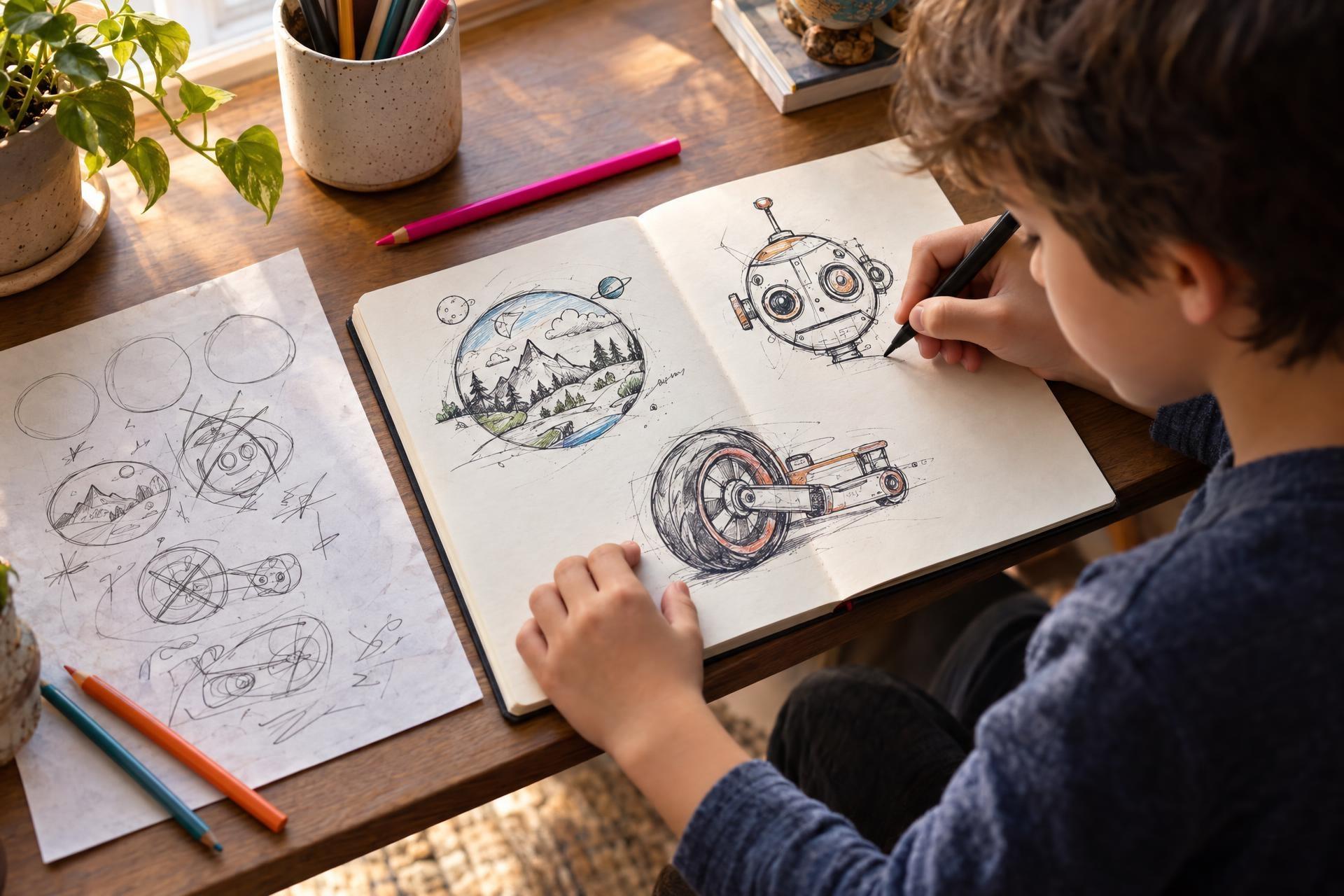
A simple prompt can involve several creative thinking moves. Consider this one: draw three random circles, then turn each circle into something different.
| Creative habit | What a child might do while drawing |
|---|---|
| Observation | Notice that a circle could become an eye, a planet, a wheel, a bowl, or a doorway. |
| Idea generation | Move beyond the first answer and look for several possibilities. |
| Connection-making | Combine familiar things in an unfamiliar way, such as a planet with a zipper or a wheel for a house. |
| Experimentation | Try a line, color, pattern, or shape to see whether it communicates the intended idea. |
| Revision | Change a part of the drawing when a new possibility appears. |
| Communication | Use visual details to help someone else understand what the picture is meant to show. |
Not every drawing session will include every one of these moves. The point is not to turn art time into an assessment. It is to recognize that the process can invite them—and to make room for them.
Why the “second version” is especially valuable
Many children, especially those who worry about being good at art, assume a first attempt should be the final one. A helpful alternative is to make a second sketch normal.
For example, invite your child to draw a robot that helps at home. Then ask them to redraw that robot for a different setting: a farm, a school, a spaceship, or an underwater research station. The second version is not a correction. It is an opportunity to ask, “What would need to change here?”
Perhaps the home robot carries laundry, while the farm robot has wide wheels and a seed tray. The child has to consider purpose, environment, and trade-offs. This is creative problem-solving in a form that feels playful and manageable.
A useful message to reinforce: Changing an idea does not mean the first idea was wrong. It means the idea is developing.
Try a short revision routine
- Ask your child to circle one part they like.
- Invite them to add one detail that makes the idea clearer or more interesting.
- Have them make a tiny alternate sketch in a corner rather than erasing the original.
Drawing activities that encourage flexible thinking
The best prompts offer a starting point without prescribing a right answer. They reduce blank-page pressure while leaving ownership with the child.
Playful transformations and visual stories
- Shape transformation: Draw three lines or shapes. Turn each one into a different object, creature, place, or invention.
- Many-answers challenge: Ask, “How many ways can you draw a place to read?” A treehouse library, an underwater book nook, and a train-car reading room all count.
- Four-panel comic: Make a wordless comic. The challenge is to make the action and feelings understandable through pictures alone.
- What happened next? Draw a character finding an unusual object, then add two more panels showing what they decide to do with it.
Design, world-building, and point of view
- Redesign challenge: Carefully draw an everyday object, then redesign it for an unusual user: a backpack for a dragon, a lunchbox for an astronaut, or a bike for a city with constant rain.
- Character with constraints: Design a character who cannot speak, travels only at night, or is responsible for protecting a secret place. How will the visual details reveal that?
- Same scene, new perspective: Draw a familiar place from the viewpoint of a pet, a tiny insect, a visitor from another planet, or someone arriving during a storm.
- World-building page: Create a map, a vehicle, an object from daily life, and one rule for an imagined world. Then add a second rule that creates a problem for its inhabitants to solve.
These activities work with pencil and paper, markers, a tablet, or a digital drawing program. The medium matters less than the opportunity to make decisions, take a risk, and explore more than one possibility.
Better questions than “What is it?”
Parents do not need art expertise to support creative thinking. Often, the most helpful shift is moving away from evaluating the finished picture.
Instead of focusing only on whether a drawing is pretty, realistic, or neat, ask questions about the child’s choices and ideas:
- “What detail matters most in this picture?”
- “What else could this become?”
- “What was the first thing you decided to add?”
- “How could you show that this character feels worried without using words?”
- “If this place had a sound, what would it be?”
- “What would change if this happened at night?”
- “Want to try a second version with one big change?”
- “Tell me about the part that surprised you.”
Parent tip: These questions are invitations, not a quiz. If your child would rather keep drawing than talk, let the drawing time stay theirs. A simple observation—“I notice you gave it really long legs”—can be enough to show that you are paying attention.
What research can—and cannot—tell us
Research gives reason to take children’s drawing seriously as more than decoration. A large study of children’s line drawings found that, as children grew, their drawings increasingly included meaningful visual details that helped communicate the intended concept. That supports the idea that drawing can reflect and exercise children’s developing ways of representing ideas about the world.
Other research has found benefits from generative drawing in particular learning settings. For instance, a classroom study with fifth graders found that drawing during an ancient Chinese poetry lesson supported learning and motivation compared with repeated reading in that context. These findings are promising, but they do not prove that drawing by itself produces broad, lasting creativity across every subject or situation.
That distinction matters. A child’s drawings are not a diagnosis of intelligence, emotions, or learning ability. Nor is realism a measure of creativity. The most useful takeaway is simpler: drawing can be one accessible way to practice making ideas visible, flexible, and discussable.
Parallel developmental changes in children’s production and recognition of line drawings of visual concepts
Drawing as a strategy for children to learn ancient Chinese poetry
How to keep drawing from becoming another performance task
Children are more likely to explore when the stakes are low. A few small choices can protect that feeling:
- Offer choices, not assignments. Give two or three prompts, or let your child change the prompt.
- Keep materials easy to reach. A small sketchbook and a few favorite tools invite more frequent, casual use than a carefully guarded art set.
- Model imperfect making. Draw alongside your child occasionally, including your own uncertain lines and revisions.
- Value quantity sometimes. Five tiny thumbnail sketches can be more freeing than one drawing expected to be perfect.
- Do not rush to fix. If a child is frustrated, ask whether they want an idea, a break, or simply company.
- Follow their interests. Sports, animals, fashion, fantasy maps, vehicles, games, and manga-inspired characters can all be rich material for creative practice.
The goal is not to produce a child who always loves drawing. It is to help them experience an idea as something they can explore, reshape, and communicate.
What parents can do next
- Set out paper or open a drawing app and invite your child to transform three random shapes into different things.
- Give the activity about ten minutes, without correcting proportions or suggesting a better answer.
- If your child wants to continue, invite them to make a second version of their favorite idea with one big change.
- Ask one open question about a choice they made, or simply share an observation about a detail you notice.
If your child stops after one page, that counts too. The value is in the repeated opportunity to observe, imagine, make, and revise—not in a perfect finished drawing.
Frequently asked questions
Does my child need to be good at drawing to benefit?
No. Realism, neatness, and technical skill are not measures of creativity. Rough sketches, doodles, and first attempts can all provide opportunities to notice, imagine, make choices, and revise.
Will drawing automatically make my child more creative?
Not automatically. Creativity develops through many experiences, relationships, interests, and chances to make real choices. Drawing can be a valuable practice space for creative habits, but it is not a guaranteed shortcut to broad creativity or academic success.
Should I correct my child’s drawing or show them how to improve it?
Try not to rush to fix it. When a child is frustrated, ask whether they want an idea, a break, or simply company. Making an alternate sketch rather than erasing the original can help show that ideas can develop without making the first version wrong.
Do drawing activities need special materials?
No. Pencil and paper, markers, a tablet, or a digital drawing program can all work. The medium matters less than having room to make decisions, take a risk, and explore more than one possibility.
Explore creative process through art
For children who enjoy exploring art with prompts, techniques, and supportive feedback, live interest-led classes can offer another space to develop their own creative process.