By Samantha Dixon ·
Art Supplies for Kids: What to Buy for a First Art Class
What art supplies does your child need for a first art class? A simple starter kit, supplies by class type, safety seals to look for and setup tips.
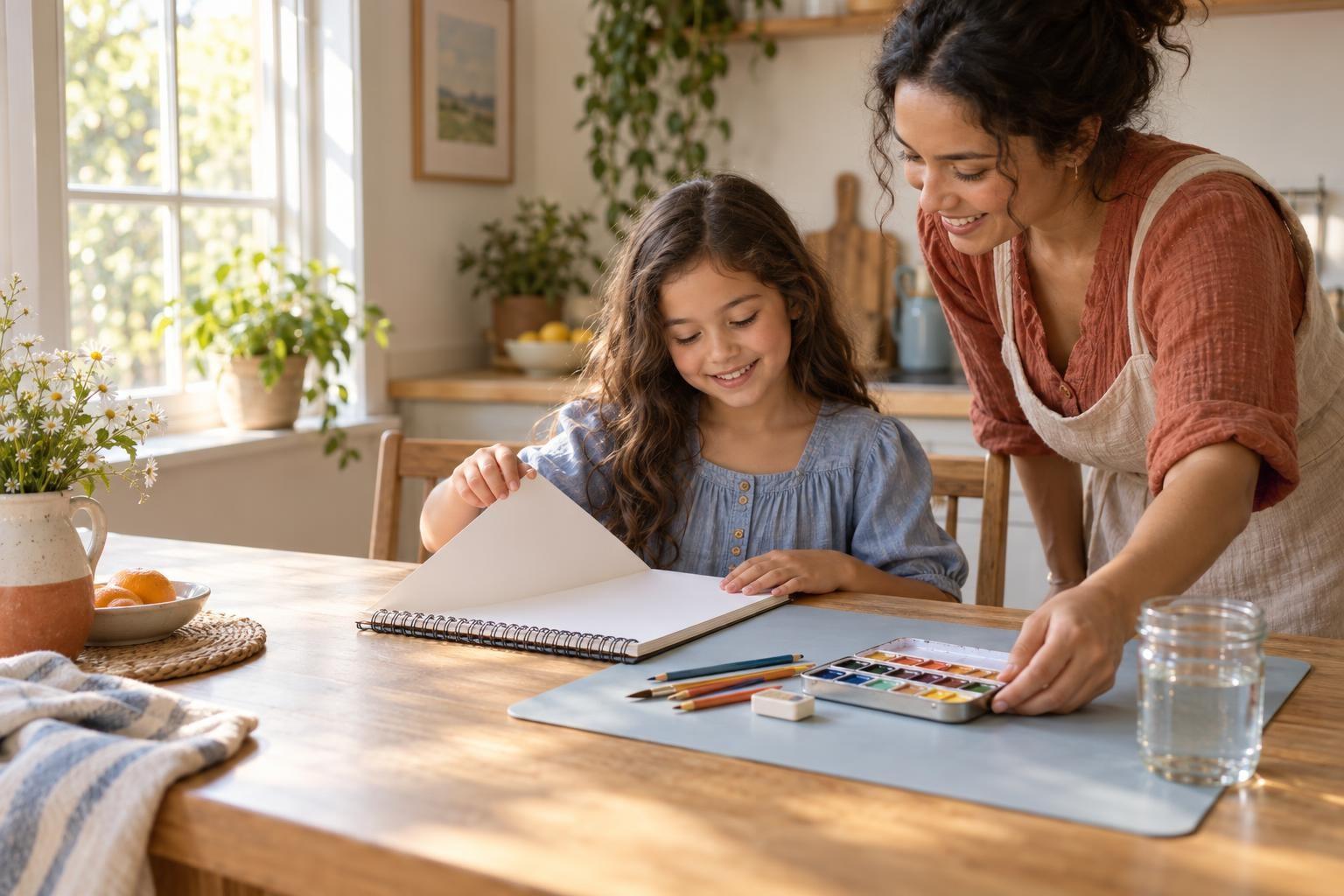
For most beginner art classes, your child needs only a sketchbook, a few drawing pencils, a good eraser and a basic set of watercolors or markers. Before you buy anything, check the class page for the teacher's supply list, so you get exactly what the lessons use and nothing that sits in a drawer.
Start small: a mixed media sketchbook, a few pencils (2H to 4B), an eraser, a sharpener and one kind of color that matches the class. Read the teacher's supply list first, spend a little more on paper than on anything else, and choose products with the ACMI AP seal for young children.
The core starter kit
These basics cover most drawing and painting classes for kids. You can find all of them at a craft store, office supply store or online.
- Sketchbook. Choose one with thicker paper, often labeled "mixed media." It handles pencil, marker and light watercolor without tearing. A spiral binding lies flat, which helps on camera.
- Drawing pencils. A small set with a range like 2H, HB, 2B and 4B is plenty. Harder "H" pencils make light lines; softer "B" pencils make dark, smudgy ones.
- Eraser. A white plastic eraser cleans up mistakes well. A kneaded eraser, which you can shape like putty, is a fun bonus for shading.
- Pencil sharpener. A small handheld sharpener with a lid catches the shavings.
- Color. Pick one to start: a pan watercolor set, washable markers or colored pencils. Match what the class uses.
Supplies by type of class
Different classes need different tools. Use this table as a quick guide, then confirm with the class page.
| Class type | Usually needed | Nice to have |
|---|---|---|
| Drawing and sketching | Sketchbook, pencils, eraser, sharpener | Blending stump, fine black pen |
| Cartoon and comics | Pencils, eraser, black fine-tip markers, paper | Ruler, colored markers |
| Watercolor | Watercolor paper or pad, pan watercolors, two brushes, water cup | Paper towels, masking tape |
| Acrylic painting | Acrylic paints, canvas board or heavy paper, flat and round brushes | Palette, smock or old shirt |
| Mixed media and crafts | Glue stick, scissors, markers, colored paper | Oil pastels, collage scraps |
How to shop smart in five steps
- Read the class supply list first. Most teachers list exactly what's needed. Some note low-cost swaps you can use instead.
- Check what you already own. Printer paper, school pencils and a plastic cup for water may be all you need for a trial class.
- Buy small sets. A 12-color set teaches color mixing better than 100 colors. Kids learn more when choices are simple.
- Spend a little more on paper. Thin paper curls and tears with paint. Good paper makes even simple work look better, which keeps kids motivated.
- Look for the safety seal. For young kids, choose products with the AP seal from the Art and Creative Materials Institute (ACMI). It means an expert reviewed the product and found it non-toxic.
Picking the right paper
Paper is the supply parents most often get wrong. Here's a quick guide:
- Drawing paper is fine for pencil and colored pencil.
- Mixed media paper is a good all-rounder for kids who do a bit of everything.
- Watercolor paper is thick and textured. It soaks up water without buckling much.
- Marker paper is smooth and keeps ink from bleeding through.
Paper weight is often listed in pounds (lb) or grams (gsm). A higher number means thicker paper.
Set up an art space for online classes
A little prep keeps class time for creating, not hunting for a brush.
- Pick a table near light. Natural light from a window is ideal. Add a desk lamp for evening classes.
- Protect the surface. Lay down a plastic tablecloth, newspaper or a cheap vinyl mat.
- Lay out supplies before class. Fill the water cup, sharpen pencils and open the sketchbook to a fresh page.
- Angle the camera. Many art teachers like to see the student's work. Prop up a tablet or tilt a laptop so the page is visible. Ask the teacher what view they prefer.
- Keep a rag or paper towel handy. Spills happen. Quick cleanup keeps stress low.
A live class makes the most of these supplies. The teacher can see your child's page and suggest a tip on the spot.
What to watch for
- Young kids and small parts. Caps, pan paints and erasers can be choking hazards for toddlers and preschoolers. Supervise closely.
- Adult-only materials. Some paints, sprays and solvents carry the ACMI "CL" seal. These need careful handling and are not meant for young children.
- Craft knives and sharp tools. Use child-safe scissors. Save cutting tools for older kids with adult help.
- Stains. Washable markers and paints save clothes and tables. Acrylic paint is hard to remove once dry.
Frequently asked questions
Do I need expensive art supplies for a beginner?
No. Student-grade supplies are fine for most kids. Upgrade paper or brushes only once your child shows real interest.
Can my child use markers instead of paint?
Often, yes. Many beginner drawing classes work well with markers or colored pencils. Check the supply list or ask the teacher.
How do I store art supplies?
A clear plastic bin or caddy keeps everything together. Store brushes bristle-side up so they keep their shape.
What should we buy for a one-off trial class?
Usually very little. Printer paper, school pencils, an eraser and a cup of water may be enough. Check the class supply list, then add better paper or paints once your child decides to keep going.
Find a first art class for your young artist
Once the kit is ready, a live class lets a teacher see your child's page and offer tips as they draw and paint.